
Wedding Fireworks Lights Manufacture: The Ultimate Buyer’s Guide
Wedding Fireworks Lights Manufacture: The Ultimate Buyer’s Guide for Magical Reception Décor (Safe, Reusable, Easy Setup)
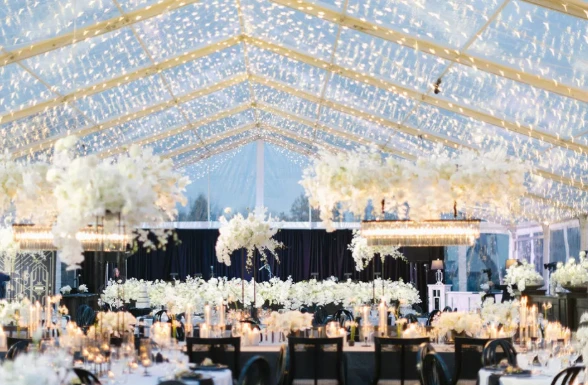
Wedding Fireworks Lights for Magical Reception Ceiling Décor
This Wedding Fireworks Lights Manufacture buyer’s guide explains how wedding fireworks lights from manufacturers combine LED technology with starburst designs to create pyrotechnic visual effects—without actual explosives. These reusable decorative lights offer venues a safe alternative to traditional fireworks while delivering dramatic lighting displays for receptions. Most manufacturers concentrate in China’s Guangdong and Hunan provinces, where production infrastructure supports both small custom orders and bulk wholesale purchases.
Why Choose LED Firework Lights? (Wedding Fireworks Lights Manufacturer Advantages)
Traditional pyrotechnic displays cost between $3,000 and $25,000 for wedding receptions, require specialized permits, and pose fire risks. For most venues, Wedding Fireworks Lights Manufacture is the simplest path to a dramatic ‘fireworks moment’ without permits, smoke, or fire risk. LED firework lights for wedding ceremonies eliminate these barriers through reusable technology that venues can deploy repeatedly without regulatory complications.
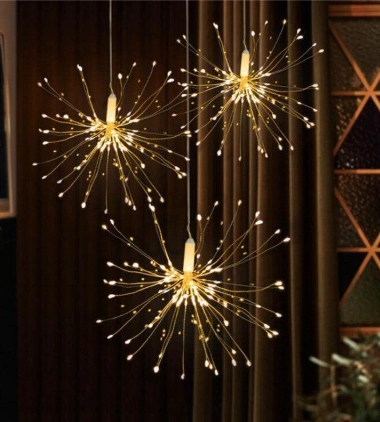
Indoor Hanging LED Firework Lights (Safe Firework Effect)
The fundamental advantage centers on safety certification. Unlike actual fireworks that contain explosive compounds, LED firework lights operate on low-voltage electrical systems (typically 12V or 24V). This classification allows indoor use at venues where traditional pyrotechnics would violate fire codes. Wedding planners report that venues charging $2,000-$5,000 premiums for pyrotechnic insurance waive these fees when couples substitute LED alternatives.
Manufacturing quality directly impacts visual authenticity. Premium wedding fireworks lights manufacturers use copper wire branches (40-60 strands per unit) that flex into three-dimensional starburst patterns. Each strand contains micro-LEDs spaced 2-3cm apart, creating the light dispersion characteristic of actual firework bursts. Lower-quality units from trading companies often feature rigid plastic branches with wider LED spacing (5-8cm), producing flat, obviously artificial effects.

Flexible Copper Wire Starburst LED Firework Light Design
The reusability factor transforms economics over time. A single LED firework light unit costs $15-$45 at wholesale, depending on LED count and control features. These units function for 20,000+ hours—equivalent to approximately 2,500 eight-hour wedding receptions. The per-event cost drops to $0.018-$0.054 compared to $150-$500 per event for consumable pyrotechnics.
How to Source Factory-Direct Wedding Firework Lights (Manufacturer vs Wholesaler)
Manufacturing verification separates legitimate factories from trading companies that dropship without quality control.When you source Wedding Fireworks Lights Manufacture directly, verification protects you from hidden quality and certification gaps. The distinction matters because direct manufacturers control production standards while intermediaries add markup without adding value.
Factory vs Trading Company: Wedding Fireworks Lights Manufacturer Verification
Request business license documentation showing company type. Chinese business licenses explicitly classify entities as “manufacturing” (制造) or “trading” (贸易). Manufacturing licenses require registered factory addresses with production facility documentation. Trading companies often list office addresses in commercial buildings.
Factory operational history indicates process stability. Suppliers with 5+ years in firework lights for wedding production demonstrate refined quality systems. Liuyang-based manufacturers like Liuyang Happiness Firing Systems (11+ years) and Guangzhou manufacturers such as Guangzhou Muguang Lighting (8+ years) show established track records. Newer operations (under 3 years) carry higher quality variance risks.
Production capacity metrics reveal manufacturing scale. Request monthly output figures for wedding LED firework lights. Legitimate manufacturers produce 5,000-50,000 units monthly depending on facility size. Trading companies cannot provide these metrics or quote suspiciously high numbers (100,000+ units) without corresponding factory evidence.
Third-party verification platforms offer additional validation. Alibaba’s “Verified Supplier” status requires business license submission, onsite facility inspection, and transaction history review. However, this verification confirms legal registration, not product quality. Request inspection reports from SGS, Bureau Veritas, or TÜV as quality evidence.
Top Manufacturing Hubs for Wedding Firework Effect Lights (Guangdong vs Hunan)
China dominates global LED lighting production with 80-90% market share. Two regions concentrate wedding fireworks lights manufacture:
Guangdong Province (Guangzhou, Shenzhen, Zhongshan) specializes in LED technology integration. Manufacturers here excel at programmable controllers, RGB color systems, and smart home compatibility. Companies like Toprex Festival Decoration and Sailwin Light & Audio Technology operate in this cluster. Expect higher prices ($25-$50 per unit wholesale) but superior technical features—app control, music synchronization, and pre-programmed wedding-specific light sequences.
Hunan Province (Liuyang specifically) maintains centuries of pyrotechnic expertise that translates to authentic firework effect design. Liuyang manufacturers understand burst patterns, color cascades, and timing sequences that replicate actual pyrotechnics. While their electrical engineering may lag Guangdong competitors, their visual effect design often appears more authentic. Wholesale costs run $15-$35 per unit.

Wedding Arch Decor with Blue Firework Effect LED Lights
Manufacturing consolidation in these regions creates supply chain advantages. Component suppliers, testing facilities, and logistics companies cluster nearby, reducing lead times from 45-60 days to 15-30 days for custom orders.
On-Time Delivery for Wedding Firework Lights Orders: Lead Time & Peak Season Risk
Delivery reliability impacts wedding timeline management more than price variations. A 10% cost saving becomes meaningless when delayed shipments force reception cancellation.
Evaluate supplier delivery metrics through platform data. On Alibaba, check “On-time delivery rate” displayed on supplier pages. Rates above 95% indicate reliable logistics. Manufacturers like Liuyang Kesheng Trading maintain 98.8% rates across hundreds of orders. Rates below 90% signal systematic fulfillment problems.
Request delivery timeline documentation for previous wedding season orders (March-October in Northern Hemisphere). Manufacturing capacity constraints during peak demand create delays. Suppliers who maintained on-time delivery during these periods demonstrate proper capacity planning.
Wedding Fireworks Lights Manufacture Specs: LED Count, Power & Certifications
Technical specifications determine whether LED firework lights deliver authentic visual effects or obviously artificial displays. Understanding these specifications prevents costly procurement mistakes.
LED Count & Brightness Standards (Wedding Firework Lights Factory Specs)
LED count per unit directly correlates with visual density. Wedding fireworks lights manufacture standards typically specify:
- Basic units: 100-120 LEDs across 40-50 copper wire branches
- Premium units: 150-200 LEDs across 60-80 branches
- Professional-grade: 200+ LEDs with multiple branch tiers
More LEDs don’t automatically mean better effects. Branch spacing and LED distribution patterns matter equally. Well-designed 120-LED units with optimized spacing often outperform poorly designed 200-LED units.
Copper wire gauge affects branch flexibility and durability. Premium manufacturers use 0.3-0.4mm diameter copper wire that bends into stable shapes without breaking. Thinner wire (0.2mm) breaks during shipping or installation. Thicker wire (0.5mm+) cannot form tight starburst patterns.
Light intensity specifications use lumens per unit. Wedding reception lighting typically requires 300-500 lumens per firework light unit for visible effects in ambient venue lighting. Lower-output units (under 200 lumens) disappear against venue lighting. Higher-output units (over 600 lumens) can overpower other décor lighting.
Power Options for Wedding LED Firework Lights: Battery / Plug-in / Solar + Remote/App
Power configuration impacts installation complexity and operational safety. Three main systems exist:
Battery-operated units provide installation flexibility but limited operation time. Standard AA battery packs (4 batteries) power 120-LED units for 6-8 hours. This duration covers typical reception timelines (4-6 hours plus setup/breakdown) but requires fresh batteries for each event. Battery units cost $18-$30 wholesale and eliminate electrical wiring needs.
Plug-in electrical units offer unlimited operation but require outlet access or extension cords. These units use low-voltage adapters (12V or 24V output) that transform standard 110V/220V power. Safety certifications become critical here—only purchase units with UL, CE, or equivalent adapter certifications. Plug-in units cost $15-$25 wholesale.
Solar-powered units suit outdoor wedding ceremonies but lack reliability for evening receptions. Solar panels require 6-8 hours of direct sunlight charging, producing 8-10 hours of operation. Cloud cover, shade, or shorter winter days reduce charging effectiveness. Solar units cost $20-$35 wholesale and work best as supplementary daytime décor rather than primary reception lighting.
Control sophistication ranges from basic on/off switches to programmable smart systems:
- Manual control: Simple power button, single static mode ($15-$20 wholesale)
- Remote control: 8-24 mode options, timer functions, brightness adjustment ($20-$30 wholesale)
- App-controlled: Smartphone integration, music synchronization, custom sequences ($30-$50 wholesale)
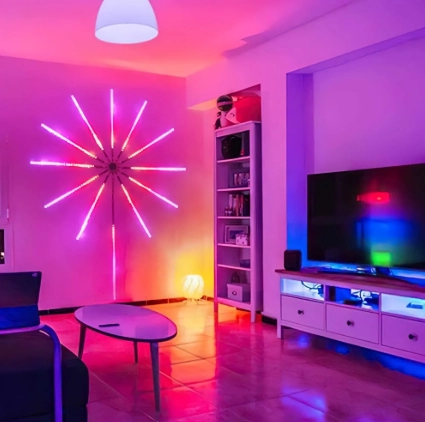
RGB App-Controlled LED Firework Light for Color-Changing Effects
Wedding reception requirements typically demand remote control at minimum. Manual units create logistical problems—staff must physically access each unit to change settings during events. App-controlled systems justify higher costs for venues running multiple weddings weekly but represent overkill for one-time personal purchases.
Certifications for Wedding Fireworks Lights Manufacture—CE, RoHS, UL/ETL & IP Rating
Safety certifications aren’t bureaucratic paperwork—in Wedding Fireworks Lights Manufacture, they verify that suppliers meet electrical safety standards that reduce fire hazards and shock risk.
CE marking indicates European safety compliance. This self-declared certification requires manufacturers to test products against Low Voltage Directive (LVD), Electromagnetic Compatibility (EMC), and RoHS standards. Request test reports showing specific compliance. Generic “CE” claims without supporting documentation mean nothing—anyone can print CE symbols on packaging.
RoHS certification restricts hazardous substances (lead, mercury, cadmium) in electrical components. This matters because LED manufacturing historically used lead-based solders and mercury in older LED formulations. RoHS-compliant manufacturing uses alternative materials. Request material safety data sheets (MSDS) as proof.
IP ratings specify water and dust resistance:
- IP44: Splash-resistant, suitable for covered outdoor areas
- IP65: Jet-resistant, appropriate for uncovered outdoor use
- IP67: Submersion-resistant for 30 minutes at 1-meter depth
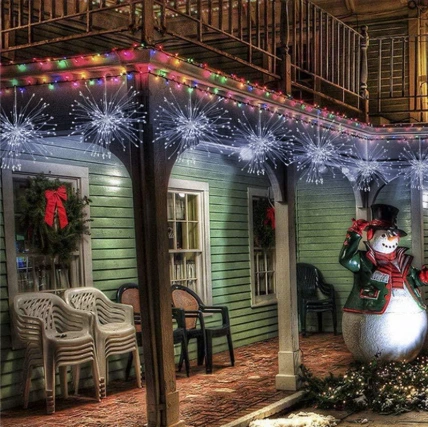
IP65 Outdoor LED Firework Lights for Weather-Resistant Installations
Wedding receptions rarely need IP67 ratings unless installing in fountains or pools. IP65 suffices for outdoor terrace installations. Indoor-only venues can use IP44 or non-rated units.
UL certification (for US markets) involves third-party testing by Underwriters Laboratories. UL-listed electrical adapters and control boxes indicate rigorous safety validation. This certification costs manufacturers $5,000-$15,000 per product line, so its presence signals investment in US market compliance.
Wedding LED Firework Lights Manufacturer Checklist: Quality, Price & Support
Systematic evaluation prevents partnering with problematic suppliers. This framework scores manufacturers across critical dimensions.
Quality Control Checklist for Wedding Firework Lights OEM (Samples, Soldering, LED Consistency)
Physical factory inspection remains the gold standard for quality verification, though virtual alternatives exist when travel isn’t feasible:
Request video factory tours showing production lines, component storage, testing equipment, and shipping areas. Legitimate manufacturers provide these tours readily. Trading companies make excuses or provide generic stock videos. Ask operators to display your company name card during the video as timestamp verification.
Demand product samples before bulk orders. Expect to pay $50-$150 for 2-3 sample units plus shipping. Manufacturers confident in quality provide samples at cost. Those refusing samples or demanding full-price purchases hide quality issues.
Analyze sample construction systematically:
- Solder joint quality: Shiny, smooth joints indicate proper technique; dull, grainy joints suggest cold solder (weak connection)
- Wire insulation: Even coating without bare wire exposure
- LED consistency: All LEDs illuminate with matching color temperature and brightness
- Casing seams: Tight-fitting, properly sealed battery compartments and junction boxes
Request third-party testing reports for electrical safety, LED lifespan, and material composition. Legitimate manufacturers maintain relationships with testing facilities like SGS or Intertek. Reports cost $500-$2,000 to generate, so their existence demonstrates quality commitment.
Wedding Firework Lights Wholesale Price Breakdown (LED Count, Controller, Volume Tiers)
Wholesale pricing for wedding fireworks lights manufacture follows predictable patterns based on specifications:
Volume-based pricing tiers:
- 100-500 units: Base wholesale price
- 500-1,000 units: 8-12% discount
- 1,000-5,000 units: 15-20% discount
- 5,000+ units: 20-30% discount, negotiable
LED count pricing correlation:
- 100-120 LEDs: $15-$22 per unit
- 150-180 LEDs: $22-$32 per unit
- 200+ LEDs: $35-$50 per unit
Control system premium:
- Manual: Baseline price
- Remote: +$3-$7 per unit
- App control: +$10-$15 per unit
Suspiciously low prices (under $12 for 120-LED units) indicate quality compromises—inferior LEDs, thin wire, weak soldering, or missing certifications. The component costs alone for quality construction run $8-$10 before manufacturing labor and overhead.
Supplier Support for Wedding Firework Lights Manufacturing: Response Time, Customization, After-Sales
Supplier responsiveness predicts long-term partnership quality. Evaluate communication during initial inquiry:
Response time metrics: Manufacturers with dedicated export departments respond within 2-4 hours during business hours. Response times exceeding 24 hours suggest understaffing or deprioritization of your inquiry size.
Technical competency: Sales representatives should answer specification questions directly without repeatedly consulting “engineers” for basic product information. Competent reps explain LED configurations, power requirements, and certification details immediately.
English proficiency: While not strictly necessary (translation tools work well), English-speaking sales staff simplify technical discussions and reduce misunderstanding-based errors. Manufacturers targeting Western markets invest in English training.
Custom order capabilities: Request information about logo printing, custom color temperatures, or modified branch configurations. Manufacturers can typically accommodate these modifications with 500+ unit minimum orders. Trading companies simply say “not possible” because they cannot modify suppliers’ stock products.
Wedding LED Firework Lights Setup Guide (Indoor & Outdoor Install)
Proper installation determines whether wedding fireworks lights deliver impressive visual effects or appear haphazard and unprofessional. Setup complexity varies by mounting location and power configuration.
Indoor Wedding Reception Setup: Ceiling Hang, Wall Mount & Pillar Wrap (LED Firework Lights)
Indoor installation offers controlled environments but requires adhesive mounting without venue damage:
Ceiling suspension creates the most dramatic firework effects. Use removable adhesive hooks rated for 2-3x the unit weight (most LED firework lights weigh 200-400g). Position hooks 6-8 feet apart in staggered patterns—avoid symmetrical grid layouts that look artificial. String clear fishing line through unit mounting loops before attaching to hooks. Adjust fishing line length to vary heights from 6 to 9 feet, creating three-dimensional depth.
Wall mounting works for smaller venues or accent lighting. Clean wall surfaces with isopropyl alcohol before applying adhesive. Test adhesion in inconspicuous area first—some painted surfaces don’t hold adhesive well. Mount units 4-6 feet from floor level and angle copper branches outward 45-60 degrees for optimal visibility.
Pillar wrapping utilizes existing venue architecture. Wrap units around support columns using zip ties through mounting holes. Position units on pillar sides facing main sight lines. Activate units in sequence (front-to-back) to create depth perception during first dance or entrance sequences.
Power routing requires concealment for professional appearance. Run extension cords along baseboards, under tables, or through cable channels. Secure cords with clear tape or cable clips. For battery units, install fresh batteries 2-3 hours before reception start to verify operation while allowing troubleshooting time.
Outdoor Wedding Ceremony Install (IP65+): Stakes, Trees, Weatherproof Power
Outdoor installations face weather exposure and require waterproof components:
Ground stake mounting anchors units in lawns or flower beds. Push stakes 6-8 inches into soil for stability. Sandy or loose soil requires deeper insertion (10-12 inches). Position units along ceremony aisles or surrounding altar areas at 3-5 foot intervals.
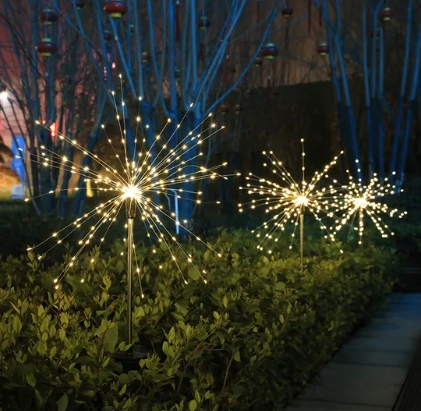
Outdoor Garden Stake LED Firework Lights for Aisles and Flower Beds
Tree branch mounting utilizes natural structures without damage. Secure units using adjustable tree straps—never nails or screws that injure trees. Select branches 2-3 inches diameter that support weight without excessive swaying. Aim for 8-12 foot mounting height for visibility over standing guests.
Weather precautions protect electrical components. Verify IP65 rating minimum for uncovered installations. Even rated units benefit from strategic positioning under eaves or tent edges when possible. Check weather forecasts—postpone installation if heavy rain predicted within 2 hours of setup. Most IP65 units withstand light rain but not installation during active precipitation.
Electrical safety demands GFCI-protected circuits for outdoor receptacles. Never use extension cords rated below 14 AWG for outdoor applications. Cover outlet connections with weatherproof junction boxes. For solar units, position panels facing south (Northern Hemisphere) or north (Southern Hemisphere) at 30-45 degree angles for optimal charging.
Lighting Sequences for Wedding Moments: First Dance, Entrance, Cake Cutting, Exit Finale
Advanced control systems enable coordinated light shows synchronized with reception milestones:
First dance enhancement: Program units surrounding dance floor to activate sequentially, creating expanding starburst effect as couple begins dancing. Use warm white or amber LED settings to complement romantic mood without overwhelming photographer’s lighting.
Grand entrance sequences: Set remote control timing to trigger all units simultaneously as couple enters reception. Chase mode settings create movement that draws guest attention. Avoid strobe effects that trigger photosensitive seizures in susceptible guests.
Cake cutting illumination: Position 2-4 units near cake table, programmed to static mode during cutting (avoiding distracting animations during photography). Activate soft fade effects between static intervals for visual interest without distraction.
Exit finale: Program all units to maximum brightness during send-off. Use color-changing modes that cycle through wedding colors. For battery units, this represents final high-drain operation, so timing 30-45 minutes before breakdown prevents mid-exit power failure.
Wholesale Pricing for Wedding Firework Lights: MOQ, Shipping & Total Cost
Understanding total cost of ownership rather than just unit price reveals true economic value. Several hidden costs inflate apparent bargain purchases.
Total Landed Cost for Wedding Firework Lights: Unit Price + Freight + Duties + Inspection
Unit cost represents obvious expense but typically comprises only 40-60% of total project cost. A $20 wholesale unit grows to $35-$45 delivered when including:
- International shipping: $3-$8 per unit depending on volume and speed
- Import duties: 2.5-6% of declared value for US imports from China
- Quality inspection: $200-$500 per shipment (optional but recommended)
- Payment processing: 3-4% for wire transfers, 4-5% for PayPal
Storage and handling add costs for venues purchasing inventory. LED firework lights require climate-controlled storage (60-80°F, under 70% humidity) to prevent LED degradation. Budget $0.50-$1.50 per unit annually for warehouse space.
Replacement rate follows typical LED lifespan curves. Expect 2-5% annual failure rate in first 3 years, increasing to 8-12% in years 4-5. Budget accordingly when calculating reuse economics.
MOQ for Wedding Fireworks Lights Manufacturer Orders—How to Negotiate (Off-Season, Stock Models)
Most wedding fireworks lights manufacturers set MOQ between 100-500 units. These thresholds exist because:
Setup costs for production runs include programming CNC bending equipment, calibrating LED testing systems, and configuring packaging lines. These costs range from $200-$800 depending on customization level. Manufacturers amortize setup costs across larger orders, making small orders unprofitable.
Shipping efficiency improves with volume. Container shipping costs $3,000-$5,000 regardless of whether 1,000 or 10,000 units fill the container. Per-unit shipping drops from $5+ for small orders to under $1 for container-load volumes.
MOQ reduction strategies exist for small buyers:
- Partner with other venues to combine orders reaching MOQ
- Accept stock configurations rather than custom specifications
- Order during off-season (November-February) when manufacturers seek volume
- Negotiate higher per-unit prices ($22 instead of $18) in exchange for reduced MOQ (200 units instead of 500)
Sample order provisions: Reputable manufacturers allow 5-10 unit sample orders at premium pricing ($30-$40 per unit including shipping). These samples enable quality verification before committing to MOQ purchases.
Payment Terms for OEM Wedding Firework Lights: 30/70, Trade Assurance, LC & Escrow
International procurement involves payment timing challenges balancing supplier risk against buyer protection:
Payment method implications:
- 100% advance payment: Highest risk for buyers, provides no quality leverage. Only acceptable with extremely reputable long-term suppliers.
- 30% deposit + 70% before shipping: Standard industry practice. Deposit covers raw materials, balance due upon completion before goods leave factory. Buyer can inspect goods (or hire inspector) before final payment.
- 30% deposit + 60% before shipping + 10% after delivery: Added protection but most manufacturers reject this structure as it assumes buyer default risk.
Letter of Credit benefits: Banks act as intermediaries, releasing payment only when manufacturers present shipping documentation. LC fees cost $500-$1,500 but provide substantial protection for $10,000+ orders. Worth consideration for first-time supplier relationships.
Escrow services: Platforms like Alibaba Trade Assurance hold payment until delivery confirmation. Costs 3-5% of order value but nearly eliminates fraud risk. Ideal for $5,000-$20,000 orders where LC overhead seems excessive but risk remains significant.
Maintain Wedding LED Firework Lights for 8–10 Years: Cleaning, Storage, Repairs
Proper maintenance extends LED firework light lifespan from 3-5 years to 8-10 years, dramatically improving return on investment.
Cleaning & Storage for Wedding LED Firework Lights (Battery Removal, Coil Method, Humidity Control)
Post-event cleaning prevents dirt accumulation that degrades LED output. Wipe copper branches with dry microfiber cloth to remove dust. For outdoor units exposed to mud or debris, use slightly dampened cloth with water only—no chemical cleaners that corrode wire coating.
Battery removal before storage prevents corrosion damage. Alkaline batteries leak potassium hydroxide when stored in devices long-term. Remove batteries within 48 hours of event conclusion. Store batteries separately in climate-controlled area.
Coil wire branches carefully to prevent permanent deformation. Create loose 8-10 inch diameter coils secured with twist ties or velcro straps—never rubber bands that perish and bind wires. Store coiled units in individual bags to prevent tangling.
Climate control significantly extends electronics lifespan. Store units at 60-75°F in low-humidity environments (under 60% relative humidity). High heat (over 85°F) accelerates LED degradation. High humidity corrodes copper and electrical connections.
Troubleshooting Wedding Firework Effect Lights: Partial Failure, Dimming, Remote Range, Corrosion
Partial strand failure where some LED branches don’t illuminate indicates series wiring problems. LEDs connect in series circuits (commonly 3-5 LEDs per circuit). Single LED failure breaks circuit, darkening entire branch. Test individual LEDs with multimeter or swap branches from working units to isolate problem branches. Replace entire branch assemblies—individual LED replacement rarely cost-effective.
Dimming over time results from LED junction temperature stress or power supply degradation. If all units dim uniformly, suspect power supply voltage drop. Test adapter output voltage—should measure within 5% of rated voltage (11.4-12.6V for 12V units). If random units dim while others remain bright, LED junction degradation requires unit replacement.
Remote control range reduction stems from battery depletion in remote (easy fix) or receiver module damage (requires repair). Replace remote batteries first. If range problems persist, test remote with working units to confirm transmitter function versus receiver failure.
Corrosion on battery contacts appears as white or blue-green deposits. Clean contacts with cotton swab dipped in white vinegar. Dry thoroughly. Apply thin layer of dielectric grease to prevent recurrence.
Wedding Fireworks Lights Manufacture FAQ (Lead Time, MOQ, Certifications)
What is the typical lead time for custom wedding fireworks lights manufacture orders?
Standard lead times run 15-25 days for stock configurations and 30-45 days for custom specifications. Lead time breaks down as: raw material procurement (3-5 days), production (5-10 days), quality testing (2-3 days), packaging (1-2 days), and export documentation (3-5 days). Adding custom logo printing adds 5-7 days. Custom color temperatures or branch configurations add 7-10 days for tooling adjustments. Rush orders compress to 10-15 days with 15-25% premium fees. Plan procurement 60-90 days before event date to accommodate delays.
Can LED firework lights operate in freezing temperatures?
Most LED firework lights function in temperatures as low as -20°C (-4°F) though brightness may decrease 10-15% in extreme cold. Battery-powered units face greater challenges—alkaline batteries lose 50% capacity at 0°C and become nearly useless below -10°C. Use lithium batteries for cold-weather events as they maintain 80% capacity at -20°C. Solar units require special winterized configurations with cold-weather charge controllers. For outdoor winter weddings, plug-in electrical units provide most reliable operation.
How many firework light units should I order for a 150-person reception?
Wedding lighting designers recommend 1 firework light unit per 10-15 guests as baseline, suggesting 10-15 units for 150 guests. However, venue size and ceiling height significantly impact this ratio. High-ceiling venues (over 12 feet) require denser placement or brighter units. Outdoor tented receptions need 50% more units than indoor venues due to light dispersion in open space. For dramatic effect, consider 20-25 units creating focal point clusters around dance floor, cake table, and head table rather than uniform distribution.
What certifications must wedding fireworks lights wholesalers provide for US venue requirements?
US venues typically require FCC certification (electromagnetic interference compliance) and UL or ETL listing for electrical safety. These certifications verify products meet National Electric Code standards. Request documentation showing UL file number (format: E123456) verifiable on UL’s online certification directory. For California venues, additional Title 20 energy efficiency compliance may apply. Indoor venues often require fire marshal approval—submit manufacturer’s flame rating certification showing materials pass ASTM E84 flame spread testing.