
Christmas Neon Signs Move Beyond the Window: A Small but Growing Piece of the Street-Lighting Conversation
In the broader story of decorative street lighting—where cities are investing in permanent, architecturally sensitive fixtures and programmable bridge systems—the Christmas neon sign occupies a humbler but increasingly visible niche. It is not infrastructure in the municipal sense. But as storefronts, market stalls, and event spaces look for ways to extend holiday glow onto the street without waiting for a city contract, LED neon has become a practical, if modest, player.
The products hitting the market for the 2026 season suggest a category that is maturing in exactly the ways one might expect: better weatherproofing, more customization, and a clearer split between indoor novelty and outdoor-capable display.
What’s Actually Available
For commercial buyers and serious decorators, the most relevant options are the ones rated for outdoor use. A representative example is the Christmas Candy neon sign from PoliLED, a 100 x 48 cm panel built on mirror acrylic and PVC backing with 4 mm flexible neon tubing. It carries an IP44 rating, operates on 12V DC from a standard adapter, and is rated for temperatures from -20°C to +40°C—enough for covered exterior entryways and seasonal retail displays, though not for full exposure to driving rain . A similar deer-motif sign from the same supplier shares the IP44 specification and is positioned for storefronts, hotel lobbies, and event staging .
Customization is a recurring theme. One supplier offers a “Merry Christmas” sign in a massive 229cm x 105cm format with a waterproof upgrade option, explicitly marketed for hanging over a street. The product listing includes a customer query that reads like a city planner’s wish list: “I’m looking to make this sign to hang over a street. Is this possible? Are these weather proof? Can it be made as an arch?” . The answer, at least from the vendor, is yes—with the right options selected.
At the smaller, indoor end, the 2026 Raz Imports collection includes a 16-inch bow neon sign and an 11.75-inch “HoHoHo” block sign, both USB-powered and positioned as modern accents for mantels, shelves, and party setups . These are not street-grade, but they reflect the same aesthetic shift seen in permanent municipal lighting: neon-style LED is being treated as design, not just novelty.
The Gap Between Product and Infrastructure
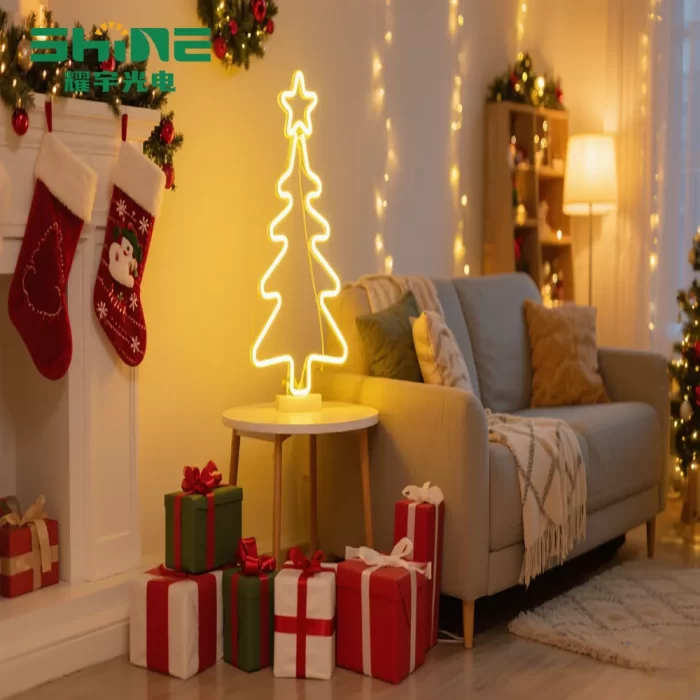
The honest assessment is that Christmas neon signs remain largely a private-sector phenomenon. A city isn’t going to replace its Fiamma luminaires with USB-powered “Merry Christmas” panels. But the overlap with the municipal conversation is real in two respects.
First, the demand signal is clear. The Cramerton pedestrian bridge project succeeded because a programmable system could deliver holiday color without annual install-and-remove labor [citation:1 in prior context]. Neon signs sold to shops and event organizers are solving a smaller version of the same problem: how to create seasonal identity without rebuilding the display every year. An IP44-rated, 12V sign that stores flat and hangs in minutes is a pragmatic answer for a business that cannot commission a lighting designer.
Second, the aesthetic language is converging. The best municipal decorative lighting—Milan’s disappearing fixtures, Yangzhou’s heritage-sensitive customizations—succeeds by restraint. The neon signs that look most promising for street-adjacent use are similarly restrained: single motifs, clean lines, warm or single-color glow rather than flashing multicolor spectacle. A candy-cane outline or a simple “HoHoHo” in steady red reads better at a distance than a chaotic animated display.
What to Watch
The practical questions for anyone considering a Christmas neon sign for street-facing use are straightforward. Check the IP rating—IP44 is adequate for covered outdoor areas, but not for full weather exposure. Confirm the power supply is appropriate for outdoor installation, not just the sign itself. And ask whether the backing and mounting hardware are rated for the same conditions as the tubing.
The larger question is whether the permanent-lighting ethos now shaping municipal projects will trickle down to the commercial products sold to the shops and markets that line those streets. If it does, the next generation of Christmas neon signs will look less like decorations and more like small pieces of storefront infrastructure: repairable, programmable, and designed to last more than one December.
That would be a modest but meaningful shift. The street doesn’t need every surface to glow. But the storefront that does glow, season after season, with something well-made and quietly festive, contributes to the same goal cities are pursuing with their permanent fixtures: a place that feels like somewhere, especially in the darkest weeks of the year.