
Decorative Lights Manufacturer vs Trading Company: What Importers Should Check
When comparing a lighting manufacturer vs trading company, the most important question is not which business model sounds better. It is who controls the work behind your order, from product specifications and production to quality checks and after-sales support.
For importers sourcing decorative lights from China, both models can be practical. A manufacturer may offer more direct access to production and technical decisions. A trading company may make it easier to source different product categories, coordinate suppliers, and manage smaller or mixed orders. The right choice depends on your products, order volume, customization needs, and internal resources.
Before choosing a China lighting supplier, compare the actual services, responsibilities, and commercial terms behind the quotation. This guide explains what to look for and provides a supplier comparison table you can reuse during procurement.
1. What Each Business Model Does
Manufacturers, trading companies, and hybrid suppliers can all support decorative lights sourcing. The main difference is how production, sourcing, and order management are organized.
The business model alone does not guarantee product quality, competitive pricing, or reliable delivery. Evaluate each supplier’s actual capabilities, documented responsibilities, and commercial terms before making a decision.
2. Lighting Manufacturer vs Trading Company: What to Compare Beyond Price
A quotation is only useful when you understand what it includes. Two suppliers may offer similar-looking decorative lights but differ in materials, customization, inspection procedures, packaging, and delivery terms.
Use the following comparison to identify the differences that matter before making a purchasing decision.
| Comparison Factor | Manufacturer | Trading Company | What Importers Should Check |
|---|---|---|---|
| Production control | May manage production directly and provide access to relevant production teams. | Coordinates production through one or more manufacturing partners. | Which production stages are performed in-house, and which are outsourced? |
| Customization | May support direct engineering discussions and production adjustments. | Can arrange customization through its factory partners. | Who approves drawings, specifications, samples, and design changes? |
| Minimum order quantity | Depends on the product, production setup, materials, and order economics. | May offer flexibility by combining products or coordinating several suppliers. | Is the MOQ calculated per model, color, design, or total order? |
| Pricing | May quote directly for its own production. | May include a service margin for sourcing and order management. | Compare equivalent specifications, packaging, inspection, and delivery terms. |
| Quality control | May manage production inspections and testing directly. | May coordinate factory inspections or conduct additional checks before shipment. | Who performs inspections, what is checked, and are records available? |
| Communication | Technical questions may go directly to the production or engineering team. | A dedicated contact may coordinate several suppliers and departments. | Who handles urgent changes and technical problems? |
| Lead time | Depends on production capacity, materials, customization, and current workload. | Depends on factory schedules and the trading company’s coordination process. | Is the timeline confirmed in writing, including sampling and approval stages? |
| After-sales support | May provide direct technical support and production-related solutions. | May coordinate replacements, spare parts, or claims with its suppliers. | Who accepts the claim, investigates the cause, and pays for the agreed remedy? |
Is Buying Direct From a Factory Always Cheaper?
No. A direct factory quotation is not automatically the lowest total cost. Compare the complete cost of fulfilling your order rather than relying on the quoted unit price alone.
Not every order includes every cost listed above. Compare quotations using the same specifications, quantities, delivery terms, and inspection requirements. This helps reveal the actual cost differences between a direct manufacturer and a trading company.
3. When a Trading Company May Still Fit
Working with a trading company can be a sensible choice in several situations.
- You need several product categories. If your order includes string lights, motif lights, solar decorations, and other products from different factories, one experienced coordinator may simplify procurement.
- You want to test a new product range. A trading company may be able to arrange a smaller or mixed order, depending on its suppliers’ MOQ requirements.
- Your team has limited sourcing resources. A supplier that handles sample coordination, export documents, packaging, and shipping can reduce the administrative workload.
- You need an established product rather than a new design. For standard catalogue products, the trading company’s sourcing and fulfillment services may matter more than direct engineering access.
- You value consolidated purchasing. One commercial contact can make it easier to coordinate different products, provided the underlying factories and responsibilities remain transparent.
The important distinction is between a trading company that adds useful services and one that cannot explain its supply chain. A reliable trading partner should be able to discuss the actual manufacturer, product specifications, inspection arrangements, delivery commitments, and procedures for handling defects.
There is no need to reject a supplier simply because it is a trading company. Instead, evaluate whether its services justify the cost and whether it can meet your order requirements.
4. How to Verify Factory Claims
SUPPLIER VERIFICATION / 4 STEPS
Verify Before You Place an Order
Follow the evidence trail from business identity to documented order responsibilities.
STEP 01
Confirm Company Identity
Compare registered business information, contract details, invoice entity, and the stated production address. Ask how the export company relates to the manufacturer when they are different entities.
STEP 02
Inspect Relevant Production Work
Request a factory visit or live video walkthrough where appropriate. For motif lights, examine relevant stages such as frame fabrication, LED placement, wiring, assembly, and the inspection area.
STEP 03
Review Quality & Compliance Records
Request applicable inspection procedures, sample records, and test documents. Confirm that each record matches the product model, configuration, and destination-market requirements.
STEP 04
Document Responsibilities
Confirm who approves samples, controls specification changes, arranges inspections, and handles defects. Record agreed responsibilities in the quotation, purchase order, or relevant agreement.
FINAL CHECK
Proceed only when the relevant evidence and commercial responsibilities are clear enough for your purchasing requirements.
For a more detailed process covering company information, factory records, certifications, and supplier red flags, read our supplier verification checklist.
5. Questions About Customization, QC and After-Sales
For decorative lights, especially products designed for commercial displays, customization and quality control can have a greater impact on project success than a small difference in unit price.
Before choosing a supplier, ask the following questions.
Customization and Engineering

The engineers are discussing the details of a custom-made, deer-shaped lamp for a client.
- Can you manufacture from our drawings, reference images, dimensions, or physical sample?
- Which changes can you make to the design, materials, frame, LED colors, wiring, or packaging?
- Are design development, samples, molds, tooling, or engineering changes charged separately?
- Will we receive drawings or a sample for approval before mass production?
Quality Control
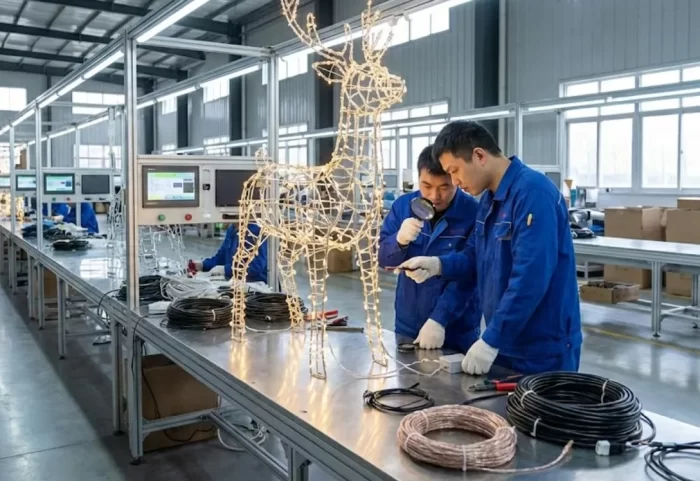
A quality inspection engineer is conducting a quality check on the deer-shaped light.
- Which incoming-material, in-process, and final inspection steps apply to this product?
- What electrical, functional, structural, or weather-resistance tests are relevant to the intended application?
- Can you provide records showing the results of the agreed inspections and tests?
- Can we appoint a third-party inspector before shipment, and what arrangements are required?
Delivery and After-Sales
- When does the quoted production lead time begin, and what could delay the order?
- How will changes to specifications or delivery dates be approved and recorded?
- What is the procedure for reporting defective products or shortages?
- Who covers replacement parts, rework, or other remedies under the agreed warranty terms?
For example, a custom 3D motif light project can involve a design brief, a 2D sketch, a 3D model, structural planning, frame fabrication, LED placement, assembly, testing, and packaging. Shinesall’s published custom 3D motif light process describes these stages. Buyers can use a similar stage-by-stage approach to ask any prospective supplier for drawings, approval records, and evidence of the work completed.
The purpose is not to demand that every supplier use an identical process. It is to establish whether the supplier has a clear, documented process appropriate to the product you are ordering.
6. Decision Checklist
Use this checklist to decide which business model deserves priority during your supplier search.
A Manufacturer May Be the Better Fit If:
- You need a custom design or repeated product modifications.
- You want direct discussions with production or engineering staff.
- Product consistency across repeat orders is a major requirement.
- You need a clear view of production stages and inspection responsibilities.
- Your order volume and specifications fit the manufacturer’s production arrangements.
A Trading Company May Be the Better Fit If:
- You need to source several unrelated product categories.
- You want one supplier to coordinate multiple factories and shipments.
- Your initial order is small or mixed and the supplier can confirm workable terms.
- You need sourcing, documentation, and export coordination support.
- The company is transparent about its manufacturing partners and accepts clear responsibility for the order.
Copyable Supplier Comparison Worksheet
Use the table below to compare two or more suppliers on the same basis. Complete it during quotation review, sample evaluation, and supplier verification. Do not leave important differences hidden in email conversations.
| Evaluation Item | Supplier A | Supplier B |
|---|---|---|
| Company name and business model | ||
| Actual manufacturer and production address | ||
| Relevant production capabilities | ||
| Customization and engineering support | ||
| MOQ by model or design | ||
| Sample fee and sample lead time | ||
| Mass-production lead time | ||
| Unit price and quotation validity | ||
| Packaging, freight, and other costs | ||
| Quality inspection and testing records | ||
| Product-specific compliance documents | ||
| Third-party inspection arrangements | ||
| Defect handling and warranty terms | ||
| Communication and change-control process | ||
| Estimated total landed cost |
Once the worksheet is complete, identify the requirements that cannot be compromised. A supplier with a slightly higher quotation may still offer better value if it provides stronger quality controls, clearer customization procedures, or more reliable delivery commitments.
Frequently Asked Questions
Is a lighting manufacturer always cheaper than a trading company?
No. Pricing depends on order quantity, product specifications, production efficiency, sourcing arrangements, and commercial terms. Compare equivalent products and total landed costs rather than assuming a direct factory will always offer the lowest price.
Can a trading company provide customized decorative lights?
Yes. A trading company can coordinate custom production through its manufacturing partners. The buyer should confirm who develops the design, approves the sample, controls production changes, and takes responsibility for quality.
How can I tell whether a China lighting supplier is a real manufacturer?
Review its registered business information, production address, relevant manufacturing evidence, product-specific records, and explanation of which stages are performed in-house. For complex orders, consider a factory visit or independent inspection.
Should I choose a manufacturer or trading company for bulk motif lights?
Start with the project’s technical and commercial requirements. If the order involves proprietary designs, engineering changes, or repeated production runs, direct factory communication may be valuable. If you need multiple product categories and consolidated sourcing, a qualified trading company may also be suitable.
Choose a Supplier Based on Your Actual Order Requirements
The decision between a manufacturer and a trading company should come down to production control, customization, order flexibility, quality assurance, and accountability. Neither business model guarantees a successful order on its own.
For importers planning decorative lights sourcing from China, the most effective next step is to prepare a clear specification and compare suppliers against the same requirements. Define the product design, quantity, intended application, destination market, packaging, inspection requirements, and delivery deadline before evaluating quotations.
Explore our factory-direct decorative lighting options and learn about our manufacturing background to understand our product range and capabilities. You can also review how our production process works when assessing manufacturing and quality-control requirements.
Ready to discuss a standard product or a custom lighting project? Discuss your order requirements with our team so we can review your specifications, quantities, customization needs, and delivery schedule.