
Christmas Motif Lighting Trends for 2025: Commercial Display Styles & Planning Ideas
The aesthetic language of commercial holiday lighting shifts meaningfully every season. For procurement teams, mall operators, and streetscape planners, 2025 arrives at an interesting moment: smart LED systems have reached reliable commercial scale, sustainability has moved from a selling point to a procurement baseline, and the bar for destination-worthy holiday environments keeps rising.
This guide maps the dominant visual directions, emerging display styles, and planning frameworks shaping this season—so your team can brief vendors and allocate budgets with clarity before the planning window closes.If you need a broader foundation on motif light types, applications, and buying considerations before comparing this season’s display directions, see our Motif Light Guide for Commercial Projects.
What Is Driving This Season’s Direction
Three shifts are worth naming before getting into specific styles, because they explain why certain aesthetic directions are gaining ground.
Holiday environments are now traffic strategy. In mixed-use retail and hospitality districts, festive lighting has been repositioned as a primary footfall driver. That changes the brief: a display needs to justify itself against occupancy and dwell-time outcomes, not just look festive.
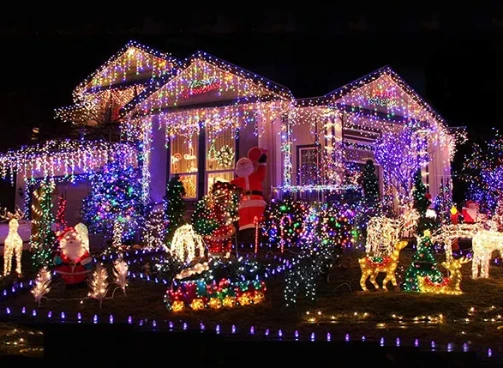
Luxurious Christmas light decorations have brought traffic to the trendy street.
Controllable LED systems have become standard territory. Color-shifting motifs, synchronized animation, and scheduled sequencing were cautious pilot choices a few seasons ago. For a practical reference on digital lighting control infrastructure, see the DALI lighting control overview.They are now reliable enough to specify with confidence at commercial scale.
Energy performance is baked into procurement, not added to it. LED motif efficiency is no longer a differentiator—it is assumed.For a current benchmark on efficient seasonal light strings, see ENERGY STAR decorative light strings. What vendors are now competing on is design range, control capability, and longevity.
Five Display Directions Worth Planning Around in 2025
1. Monochromatic Architectural Integration
Single-temperature white has become the default choice in premium retail, hospitality, and civic contexts—and with good reason. A display built entirely in warm or cool white reads as considered rather than generically festive, and it tends to strengthen rather than fight the architecture it sits against.
Warm white tends to suit aspirational contexts—high-street fashion precincts, hotel forecourts, fine dining districts. Cool white leads in contemporary civic spaces, technology campuses, and venues pursuing a crisper, more Nordic register.
Fits: High-end retail corridors, hotel and hospitality exteriors, venues where the building itself is the visual centrepiece.
Before specifying: Color temperature is a system-level call. Mixed temperatures across a contiguous streetscape read as inconsistent even when individual pieces are strong. Lock it in the brief before vendor conversations start, and hold to it across every element.
2. Oversized Statement Motifs as Wayfinding Anchors
Scale has shifted from a budget indulgence to a planning strategy. Large-format motifs—stars, snowflakes, dimensional figures at 60 inches and above—are being used as spatial anchors at entries, pedestrian intersections, and sight-line endpoints. The principle is closer to environmental design than decoration: a landmark piece tells visitors where the experience begins and ends.
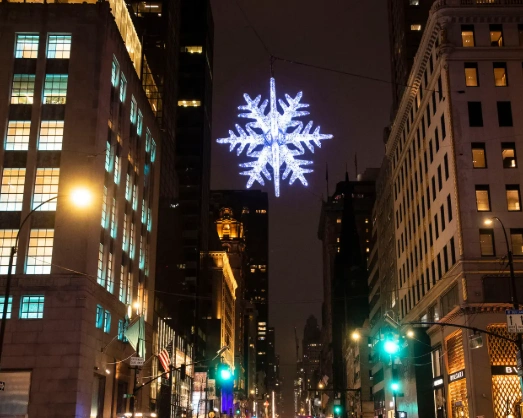
Oversized snowflake motif Christmas lights over a city street
Oversized installations also photograph in ways smaller arrangements rarely do, and that tends to drive organic sharing without any additional effort from the marketing team.
Fits: District entries and exits, major pedestrian crossings, atrium focal points, positions visible from both street level and upper-floor angles.
Before specifying: Identify anchor positions first—two or three per zone is typical—then fill supporting areas with medium-scale pieces. Spreading budget evenly across all positions is the most common reason commercial displays read as adequate rather than memorable.
For deployment logic in these spatial anchoring roles, see Commercial Lighting Motifs for Retail and Public Spaces: Pre-Installation Planning.
3. Dynamic Color-Shifting and Synchronized Animation
A few seasons ago, animated motif sequences were a cautious pilot choice. This season they are standard-specification territory. Color transitions, variable-intensity effects, choreographed ripple patterns—all are reliably deployable at commercial scale now.
For venues with existing lighting control infrastructure, animated motifs can often integrate directly. For those without, the control layer is typically the larger cost and lead-time item—budget for it separately.
For procurement planning before the installation window closes, see Christmas Motif Lights: The Complete Buying Guide for Outdoor and Commercial Displays.
Fits: Entertainment-led retail, food and beverage precincts, event spaces with timed evening programming.
Before specifying: Animation requirements belong in the brief alongside color temperature and size. Ask to see animation demos during specification, not after the hardware is installed.
4. Projection-Hybrid Displays
Pairing physical motif structures with projected animation is one of the more genuinely new directions this season. Motifs with translucent or semi-reflective elements—acrylic panels within snowflake frames, for instance—respond to projected content in ways solid rope-light frames cannot. The result is layered depth that neither element achieves on its own.For material-level guidance on acrylic panel performance, see 2D Motif Light Materials: PVC vs Acrylic for Outdoor Durability.
Projection vendors are now producing content libraries specifically designed for this kind of motif interaction, a category that barely existed a few seasons ago.
Fits: Architectural facades, covered atriums, venues with sufficient throw distance and manageable ambient light levels after dark.
Before specifying: Motif supplier and projection team need to coordinate before positions are finalized. Retrofitting projection to an already-installed layout is expensive and rarely lands cleanly.
5. Vintage-Modern Hybrids with Narrative Theming
A counter-directional approach is gaining ground in certain commercial contexts: displays that reference mid-century Christmas iconography—filament-style bulb profiles, classic sleigh silhouettes, geometric ecclesiastical forms—built in contemporary LED construction. The appeal is straightforward differentiation at a moment when monochromatic white has become the default premium choice.
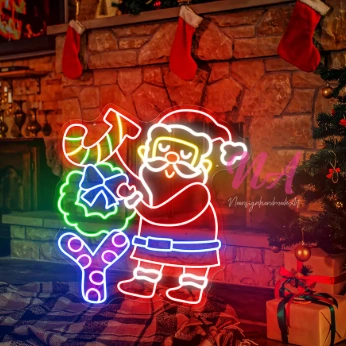
LED Neon Santa motif Christmas lights by the fireplace
Execution depends on consistency across the whole system. Vintage-modern reads as deliberate only when frame finishes, LED color rendering, and supporting elements (signage, garland tone, prop selection) are specified together. Individual vintage motifs dropped into an otherwise standard display feel incidental rather than themed.
Fits: Family-oriented retail centers, historic downtown districts, neighborhoods where a warm and nostalgic register matches the catchment and tenant mix.
Before specifying: Brief the vendor on the full visual language. Frame finish and color rendering quality carry as much weight here as dimensions and weatherproofing.
Matching Direction to Venue Profile
Not every approach fits every context. The mapping below offers a starting orientation before briefing design partners—most venues will combine two directions across different zones rather than applying one exclusively.
| Venue Profile | Best-Fit Direction |
|---|---|
| Luxury retail / high-street fashion | Monochromatic architectural integration |
| Entertainment-led retail / F&B precinct | Dynamic animation with choreographed sequencing |
| Historic downtown / mixed-use neighborhood | Vintage-modern hybrid with narrative theming |
| Contemporary civic space / tech campus | Monochromatic (cool white) + oversized anchors |
| Family retail center / community mall | Vintage-modern or animated color-shifting |
| Large-format covered atrium | Projection-hybrid + oversized statement anchors |
Planning Frameworks
Anchor-Bridge-Fill Structure
Strong commercial displays operate across three spatial tiers:
- Anchor positions (1–3 per zone): Hero motifs at entries, intersections, and sight-line endpoints. These carry the display’s visual identity.
- Bridge elements: Medium-scale motifs and rope-light runs connecting anchor pieces along colonnades, fence lines, or building facades.
- Fill layer: Smaller accent motifs and planter-scale pieces that reward close-proximity viewing without competing with anchors.
Allocating budget in proportion to tier impact—rather than spreading spend evenly—consistently produces stronger results.
Sight-Line Mapping Before Specification
Before specifying sizes and positions, map the primary viewing angles: street approach, internal pedestrian flow, and upper-level views from terraces or parking structures. Flat rope-light motifs suit single-direction viewing. Dimensional motifs are the right specification for courtyard, atrium, and island positions where viewers approach from multiple angles.
Power Infrastructure Audit
Animated and color-shifting systems increase per-circuit load compared to static LED displays. Build a power zone map—outlet locations, circuit capacities, cord run distances—into the planning timeline well before installation begins. Surprises at installation week are avoidable with an early audit.
Energy Data as a Reporting Baseline
For operators with sustainability reporting requirements, capturing wattage per display unit in 2025 creates a usable baseline for future comparison cycles. The combination of modern LED motifs and smart timer scheduling—particularly systems that adjust automatically for daily sunset variation—tends to produce meaningful reductions in seasonal energy consumption compared to legacy incandescent or unmanaged LED installations.
What a Strong Vendor Brief Looks Like This Season
Lead with direction before specification. A brief that actually helps a design partner develop a proposal—rather than a specification sheet they are asked to price line by line—covers:
- Aesthetic direction and venue profile — which of the five approaches applies, and the rationale
- Display structure — anchor positions, size ranges per tier, and key zones
- Control requirements — static, timer-managed, or dynamic/animated; existing infrastructure if relevant
- Color temperature as a system-level specification
- Performance and durability expectations framed as outcome requirements, not technical parameters
If your programme requires custom shapes or branded designs, see Custom Motif Lights for Commercial Projects: OEM/ODM Process, Sampling, MOQ and Delivery.
A Note on What Comes Next
Display systems that respond to event schedules, social triggers, and app-managed sequencing are already running in select flagship installations and moving into wider use. Operators who invest in controllable LED infrastructure and adequate power capacity this season will have less ground to cover when that becomes routine. For most teams, the 2025 brief is complete on its own: clear on direction, matched to the venue, and built around how the space actually works.
For zone-by-zone layout approaches and spatial deployment concepts, see our related guide: Christmas Motif Lighting Ideas for Outdoor Displays: 5 Commercial Layout Concepts.