
LED Firework Lights Manufacturer: Commercial Outdoor Decoration Guide
LED firework lights are permanent or seasonal outdoor decorative fixtures that simulate a fireworks burst using RGB or RGBW LEDs mounted on a radial frame — no pyrotechnics, no fire risk, no noise ordinance. They are manufactured in heights from 2M to 5M, rated IP65 for all-weather installation, and available with DMX512 control for synchronized multi-unit displays. Commercial buyers — municipalities, shopping centers, hotels, and holiday décor contractors — source them in bulk from manufacturers that support custom color, voltage (12V–230V), and OEM packaging.
What Commercial LED Firework Lights Are (and What They Are Not)
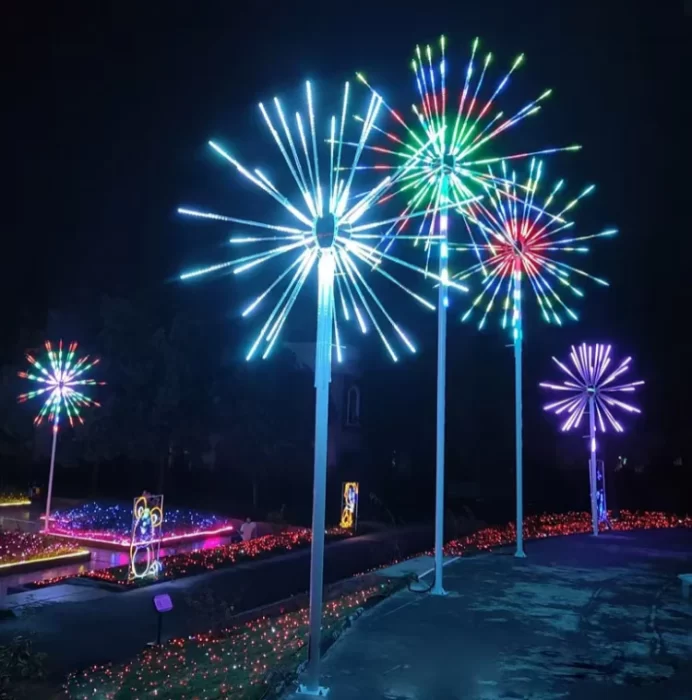
The term “firework lights” covers a specific product category in commercial outdoor decoration: a radiating LED structure mounted on a powder-coated steel pole, designed to replicate the visual burst of a pyrotechnic shell. The resemblance is intentional. Municipalities and venue operators increasingly use them as a permanent alternative to annual fireworks events, avoiding liability, permitting costs, and weather cancellations.
They are sometimes listed under related names — LED sparkler lights, firework LED lights, fireworks LED lights, or LED starburst lights — all referring to the same structural category. The distinction matters for procurement because spec sheets, MOQ tiers, and certification requirements vary by the name a supplier uses.
What they are not: consumer string lights marketed as “firework-shaped,” cold spark machines, or pyrotechnic firing equipment. This guide covers the commercial-grade, pole-mounted LED firework fixture used in permanent and semi-permanent outdoor installations.
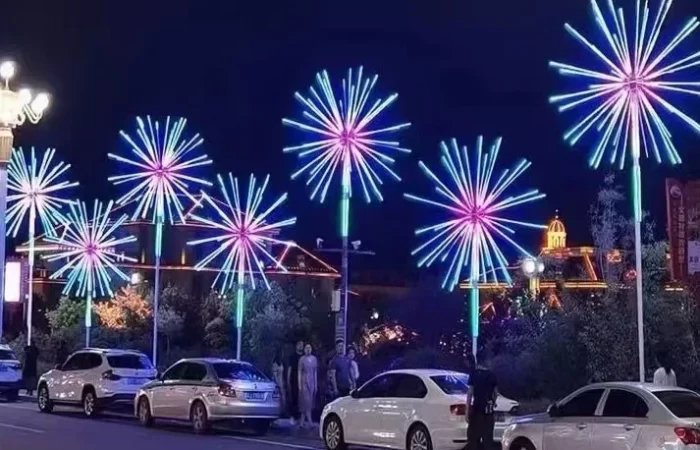
Commercial LED Firework Lights for Streetscapes
Core Product Specifications for B2B Buyers
Commercial LED firework lights share a common engineering baseline across reputable manufacturers. The table below outlines the standard spec range that procurement teams and project engineers should evaluate before issuing an RFQ.
| Parameter | Standard Range | Notes |
|---|---|---|
| Height | 2M – 5M | 2M–3M for gardens/yards; 4M–5M for parks, plazas, streets |
| LED Type | RGB / RGBW / Single color | RGBW adds a white channel for daylight-readable white output |
| Waterproof Rating | IP65 | Required for all permanent outdoor installations |
| Voltage | 12V – 230V | Multi-voltage supports global market deployment |
| Control | Static / Remote / DMX512 | DMX required for synchronized multi-unit or multi-zone displays |
| Frame Material | Powder-coated steel | Powder coat lasts significantly longer than spray paint; rust-resistant |
| LED Enclosure | UV-resistant PVC tube | Prevents yellowing and clouding over long outdoor service life |
| Wire | Pure copper | Better conductivity and longevity versus aluminum alternatives |
| Branch structure | Detachable tubes | Enables flat-pack shipping and field replacement of individual arms |
| MOQ (typical) | 50 – 500 units | Varies by manufacturer; OEM/ODM usually requires higher volume |
IP65 and Why It Matters for Specification
IP65 is the minimum rating for outdoor LED fixtures exposed to rain and cleaning. The “6” indicates complete dust protection; the “5” indicates protection against low-pressure water jets from any direction. For commercial installs in open plazas, parking lots, or street-pole applications, IP65 is the threshold — not a premium feature. Buyers sourcing from B2B platforms should confirm IP65 certification with third-party test documentation, not just a self-declared spec sheet.
DMX512 Control: When You Need It and When You Don’t
DMX512 is the industry-standard protocol for professional lighting control. For LED firework lights, it matters in three scenarios:
- Multi-unit synchronized displays: shopping mall atriums, hotel lobbies, or plaza installations where all units need to fire a sequence together
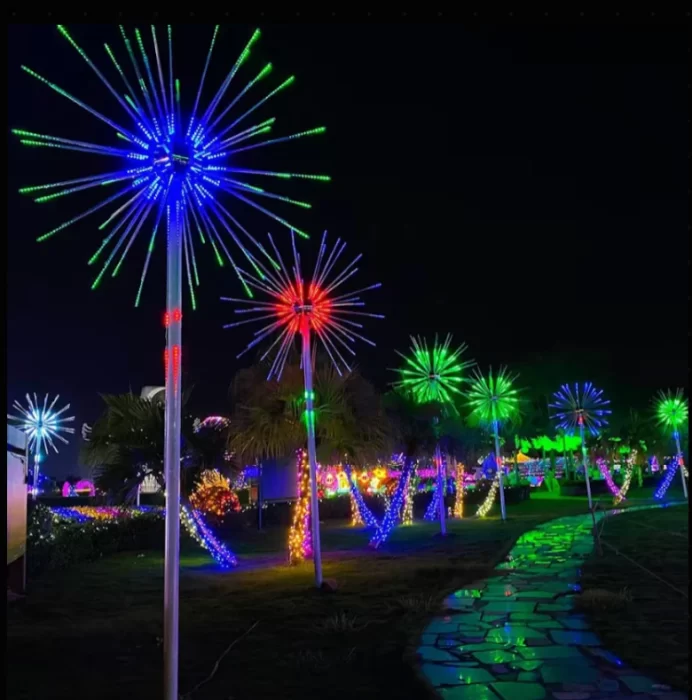
Synchronized RGB LED Firework Lights for Park Displays
- Seasonal reprogramming: changing color patterns from a holiday palette to a national day color scheme without hardware changes
- Integration with a venue’s existing lighting console: DMX lets firework lights feed into the same control system managing architectural uplights, façade lighting, or event stage rigs
For single-location, static installs — a hotel entry or a garden feature — a remote-controlled unit is sufficient and easier to operate. DMX adds cost and requires a controller and trained operator; specify it when the project genuinely needs it.
Commercial Applications by Buyer Type
Municipalities and Public Space Projects
LED firework lights — also known in the commercial trade as polestar lights or starburst lights — are a staple of municipal holiday programs, supplied to cities, towns, parks, and public attractions. The buying process for government entities typically goes through a public tender or approved vendor list, so manufacturers that hold relevant certifications (CE, RoHS, ETL) and can supply compliance documentation have a structural advantage.
Key procurement considerations for municipal buyers:
- Multi-year durability: commercial installs are capital assets expected to last 5–7+ seasons
- Wind load rating for pole-mounted units on streetscapes
- Voltage compatibility with local grid infrastructure (110V in North America, 220V–230V in Europe and Asia)
- MOQ and lead time alignment with seasonal installation windows
Shopping Centers and Retail Districts
Retail property managers use LED firework lights to drive foot traffic and anchor seasonal visual merchandising programs. Their illuminated radial design creates a bold burst effect that draws attention from long distances, making them effective in parks, shopping centers, downtown districts, entertainment venues, and large commercial holiday programs.
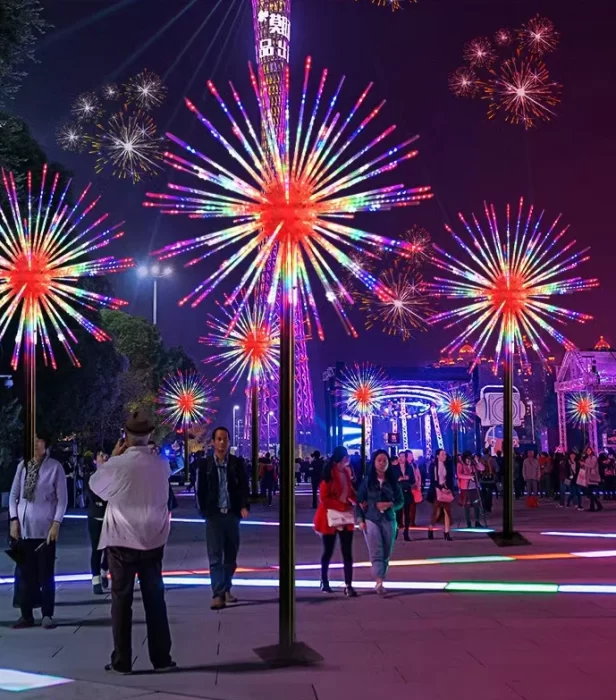
LED Firework Lights for Shopping Centers and Plazas
For mall procurement teams, the relevant factors are installation speed (detachable branch tubes reduce setup time significantly), storage footprint in the off-season, and visual compatibility with existing décor programs. Multi-color RGBW units give more programming flexibility than fixed-color options.
Hotels, Resorts, and Hospitality Groups
Hotels use LED firework lights in two modes: permanent garden or pool deck installations that run year-round, and seasonal entrance or event space displays. Permanent installs justify higher-spec units — better UV resistance, heavier gauge frames, and IP65 certification are non-negotiable for fixtures that stay outdoors 365 days a year.
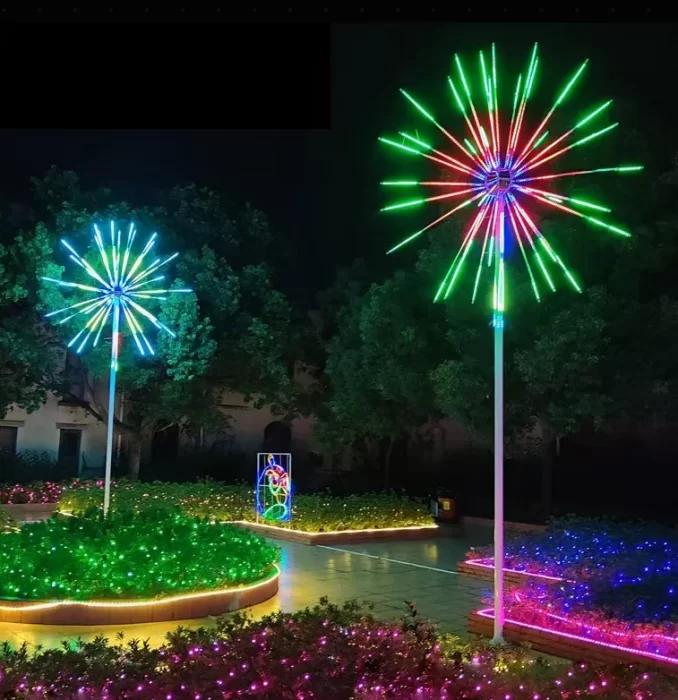
RGB LED Firework Lights for Hotel Courtyards
Hospitality buyers often require custom color to match brand guidelines. Most commercial manufacturers accommodate color customization — specific LED hue selection, custom pole finish, or branded packaging — as part of an OEM order, typically above a minimum volume threshold.
Holiday Décor Contractors and Installers
Holiday décor contractors serving shopping centers, municipalities, event organizers, and holiday decorators represent a significant B2B buying channel. These buyers purchase LED firework lights as part of a wider product portfolio — alongside LED spheres, snowfall tubes, and commercial string lights — and resell or install them under a service contract.
For contractors, the critical factors are: reliable supply chain (consistent product quality across multiple production batches), flat-pack shipping that minimizes freight cost, and detachable components that simplify storage and transport. Distributors in this channel often require exclusivity by territory or custom labeling as a condition of a volume commitment.
How to Evaluate an LED Firework Lights Manufacturer
The B2B market for LED firework lights is primarily served by manufacturers in Guangdong, Jiangmen, and Zhejiang provinces in China, with a smaller number of regional distributors in North America and Europe that source and white-label products. Separating reliable production partners from trading companies requires a structured evaluation.
Factory vs. Trading Company
A factory has production capacity, can show a production facility on video call, and provides raw material sourcing documentation. A trading company sources from multiple factories and resells — not inherently problematic, but it introduces a layer of quality variability and makes technical customization harder to guarantee. Buyers placing recurring orders above a certain volume (typically 500+ units annually) are better served by a direct factory relationship.
Signals of a real manufacturer:
- Can supply factory audit reports or third-party inspection certificates
- Has OEM/ODM capability with documented examples
- Can provide MSDS sheets for materials used in UV-resistant tube coatings
- Lead times are production-cycle-based, not “available from stock” for large custom orders
Certifications That Matter
- CE marking (required for EU sales)
- RoHS compliance (restriction of hazardous substances; required in EU and increasingly expected by major retail chains globally)
- IP65 test certificate from an accredited lab
- ETL listing (for North American market)
Request the actual test certificates, not just a declaration on the product page.
MOQ, Lead Time, and Payment Terms
Standard MOQ for commercial LED firework lights ranges from 50 to 500 units depending on the manufacturer and degree of customization. Fully custom orders — bespoke dimensions, non-standard colors, OEM packaging — typically require higher minimums and 45–60 day production lead times. Stock items in standard configurations can often ship in 10–25 days.
Payment terms in the B2B channel are usually 30% deposit with order, 70% before shipment, though established buyers with track records can negotiate net payment terms or letters of credit.
Product Range: From Solar to DMX-Controlled Commercial Units
LED firework lights sit within a broader family of outdoor decorative lighting that buyers often source together. Understanding where firework lights fit within that product ecosystem helps project teams assemble a complete display program from a single supplier.
Solar LED Firework Lights
Solar-powered firework lights use a small photovoltaic panel and rechargeable battery to operate without mains power connection. They are suitable for garden paths, park perimeters, and locations where running electrical conduit is cost-prohibitive. Performance trade-offs include dimmer output versus mains-powered units, weather-dependent charge cycles, and shorter LED run times on overcast days. For commercial applications in high-visibility locations, solar is typically a secondary option rather than the primary specification.
→ See the [Solar LED Firework Lights] page for full specifications and solar-specific product options.
Christmas and Holiday Firework Lights
A significant portion of LED firework light procurement is seasonal, driven by Christmas and New Year’s programs. These units are often single-color white or warm white, sometimes with a twinkling animation mode, and are designed for 6–12 week seasonal install cycles. Frame durability and storage-friendly packaging become important factors.
→ See the [Christmas LED Firework Lights] page for seasonal product configurations and holiday display pairing guides.
Outdoor Garden and Landscape Units
Smaller-scale LED firework lights in the 1M–2M range serve residential garden and landscape applications. Frame weights are lighter, voltage is typically 12V or solar, and they are sold in sets rather than single units. These differ meaningfully from commercial-grade products in material gauge and rated service life.
→ See the [Outdoor Garden LED Firework Lights] page for landscape product specifications.
The B2B Buying Process: From RFQ to Installation
Understanding the typical procurement flow helps buyers prepare documentation and set realistic timelines.
Step 1 — Define the project scope
Before contacting manufacturers, buyers should have: installation quantity and locations, height requirements by location type, voltage available at each install point, control requirements (static, remote, or DMX), any certification requirements by market, and target delivery date working backward from installation date.
Step 2 — Issue an RFQ
A clear RFQ should include quantity, product specification (height, LED type, IP rating, control type), packaging requirements, delivery port or warehouse address, and any certification documentation required. Vague RFQs produce vague quotes — manufacturers will quote standard configurations that may not fit project needs.
Step 3 — Evaluate samples
For orders above a minimum threshold (typically $5,000–$10,000 USD), requesting pre-production samples is standard practice. Evaluate the physical finish of the powder coat, the UV stability of the PVC tubes, the connector weatherproofing, and the LED output consistency across branches.
Step 4 — Production and quality inspection
For large orders, third-party pre-shipment inspection (PSI) through a certified inspection company provides an additional quality gate before final payment. Inspectors check unit count, spot-check electrical performance, verify certification marks, and confirm packaging integrity.
Step 5 — Logistics
LED firework lights in flat-pack configuration ship efficiently in standard 20- or 40-foot containers. FOB pricing from Chinese ports is the most common basis; CIF is available from some manufacturers. Buyers importing into the EU, North America, or other markets should confirm HS-based tariff classification with their customs broker in advance.
Frequently Asked Questions
What is the typical lifespan of commercial LED firework lights?
Commercial-grade LED firework lights using quality LEDs and UV-resistant PVC enclosures have a rated service life of 50,000 hours for the LED components. Frame durability depends on the powder coat quality and installation environment — properly maintained units in temperate climates routinely serve 5–8 seasonal cycles. Salt-air environments (coastal installations) may require additional protective treatment on the steel frame.
Can LED firework lights be customized for a specific color palette or brand?
Yes. Most commercial manufacturers offer custom LED color selection, frame finish colors, and OEM packaging above a minimum order quantity. RGBW units with DMX control offer the broadest flexibility since color can be adjusted via programming without changing hardware. Fixed single-color orders require a production run of the specific LED emitter, which typically requires a higher MOQ than stock RGB configurations.
What voltage options are available, and how does it affect procurement?
LED firework lights are available in voltages from 12V to 230V, designed to match different markets. North American projects typically require 110V–120V or 12V low-voltage configurations. European and most Asian markets run 220V–240V. Multi-voltage power supplies can handle a range automatically, which simplifies procurement for buyers deploying across multiple countries. Specify the grid voltage at the installation site when requesting a quote.
What is the difference between RGB and RGBW in LED firework lights?
RGB LEDs mix red, green, and blue to produce a wide range of colors, but creating a clean white from RGB results in a slightly blue-tinted output. RGBW adds a dedicated white LED chip, producing accurate neutral or warm white — important for installations that need a classic white firework effect or need to blend with white-dominant architectural lighting. RGBW units cost more per unit and require a compatible controller, but the color quality difference is visible in professional installations.
Are LED firework lights suitable for year-round outdoor installation?
Units with IP65 certification and UV-resistant PVC tube construction are designed for permanent outdoor exposure. The IP65 rating covers rain and cleaning water jets; the UV-resistant coating prevents the clear tube from yellowing or becoming opaque over time. For year-round installs, buyers should also confirm the operating temperature range of the LED driver, particularly in climates with extreme cold or heat.
Ordering and Next Steps
Commercial LED firework lights are available in standard configurations ready for bulk order, or in custom specifications for larger projects. Buyers in the planning phase can request:
- Specification sheets for standard 2M–5M units
- Pre-production samples for evaluation before full order commitment
- Project consultation for large-scale municipal or multi-site installations requiring layout planning, control system design, or phased delivery schedules
The RFQ process typically takes 2–5 business days to return a detailed quotation with per-unit pricing, MOQ tiers, lead time by configuration, and freight estimates to your destination port or warehouse.
→ [Request a Quote / RFQ] → [Download Product Specifications PDF]
Related Product Pages
- [Solar LED Firework Lights] — Off-grid and garden applications
- [Christmas LED Firework Lights] — Seasonal holiday configurations
- [Outdoor Garden LED Firework Lights] — Residential and landscape-scale units
- [LED Outdoor Decoration Lights] — Full commercial outdoor product range
Technical and compliance references: IEC IP Ratings; ANSI/ESTA ANSI E1.11 DMX512-A; European Commission CE Marking; European Commission RoHS Directive; World Customs Organization HS Nomenclature.