
2D Motif Light Materials: PVC vs Acrylic for Outdoor Durability
The face material of a 2D motif light — typically PVC-based mesh or film, or acrylic (PMMA) sheet — directly affects UV stability, weathering performance, light quality, and replacement cycle in outdoor use. Both are established materials in decorative lighting, but they suit different project conditions and budget constraints. This guide compares them on the criteria that matter most in specification and procurement: UV resistance, light output, weathering, cost, and best-fit deployment scenarios.If you need a broader overview of motif light types, applications, and buying basics before comparing materials, start with our motif light guide.
By the ShinesAll Technical Team
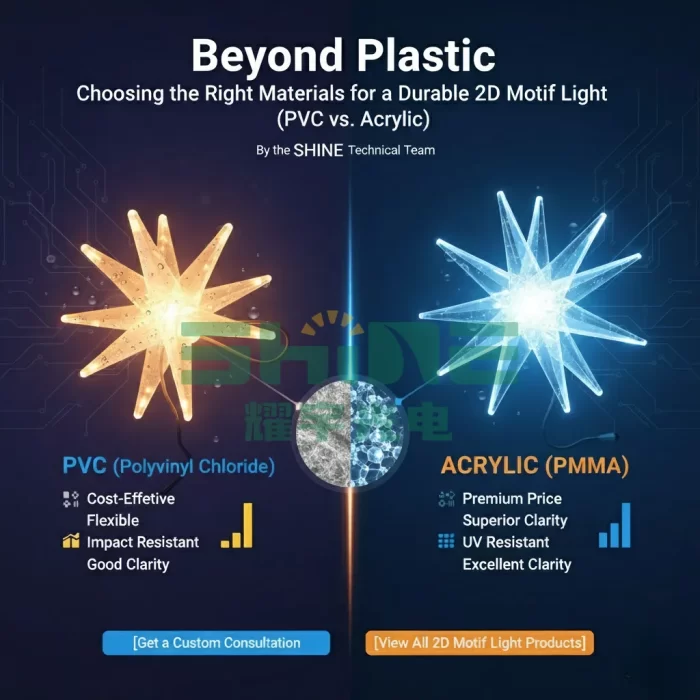
What “Face Material” Means in a 2D Motif Light
The face material is the outer layer of the motif that interacts directly with sunlight, rain, temperature changes, and the LED light source behind or within the structure. It is the part most exposed to weathering and the part most likely to show fading, yellowing, surface wear, or loss of visual quality over time.
In this guide, face materials fall into two broad forms:
- PVC-based face materials — flexible mesh, film, or decorative infill sheets
- Acrylic (PMMA) face materials — rigid sheet or panel, whether clear, frosted, or printed
This distinction matters because the face material influences UV durability, light transmission, fabrication cost, and handling characteristics in different ways.
PVC vs Acrylic Motif Light: Quick Comparison
| Property | PVC face materials | Acrylic / PMMA face materials |
|---|---|---|
| Material form | Flexible mesh, film, or infill sheet | Rigid sheet or panel |
| Light transmission | Lower and more application-dependent | Higher and more optically consistent |
| UV stability | Depends on stabiliser package | Inherently more UV-stable |
| Outdoor colour retention | Good in UV-stabilised grades | Generally more stable over long exposure |
| Temperature tolerance | More grade-dependent, typically narrower | Generally broader for outdoor use |
| Weight per unit area | Lower | Higher |
| Handling tolerance | Better at absorbing flex during transport and reinstallation | Better at holding flat geometry, but less forgiving under sharp impact |
| Upfront material cost | Lower | Higher, often around 2–3× depending on grade and thickness |
| Best-fit deployment | Large seasonal programmes and high-handling installs | High-UV, close-viewed, or longer-life installs |
UV Resistance: The Key Variable for Outdoor 2D Motif Light Material
UV radiation is one of the main causes of polymer degradation in outdoor decorative lighting. Over time, it can lead to yellowing, embrittlement, surface dulling, and reduced visual quality. This is one of the clearest performance differences between PVC and acrylic.
How PVC Handles UV Outdoors
Standard PVC is not inherently UV-resistant. Without the right additive package, prolonged exposure can trigger photooxidation, which contributes to yellowing and loss of flexibility over time.
To reduce this, manufacturers typically use UV stabiliser packages and pigments such as titanium dioxide (TiO₂), often alongside HALS or similar additives, during compounding or extrusion. UV-stabilised PVC generally performs well in moderate-UV outdoor environments for multiple seasons. The practical issue is consistency: additive type, loading level, and formulation quality vary by supplier, which makes specification and verification important for long-term outdoor use.
How Acrylic (PMMA) Handles UV Outdoors
Acrylic’s UV resistance comes more directly from the polymer itself rather than from a stabiliser-dependent formulation. In outdoor use, PMMA generally retains optical clarity and mechanical integrity better than standard PVC, especially under sustained sun exposure.
For projects in high-insolation regions — such as the Gulf, South and Southeast Asia, the Mediterranean, Southern California, or Australia — acrylic is usually the more straightforward specification choice. Its performance is less dependent on additive quality than PVC, although grade selection still matters in real installations.
As a practical optical reference: acrylic can offer light transmission of up to about 92% in suitable clear or diffuser grades, while PVC mesh or film systems are usually lower and more dependent on mesh density, finish, and long-term surface condition.
For outdoor structural durability in 3D formats, see 3D Motif Light Frame Materials: Steel vs. Aluminum for Long-Life Commercial Outdoor Installations.
Outdoor Weathering Beyond UV: Temperature, Humidity, and Coastal Conditions
Temperature Performance
PVC’s flexibility is both an advantage and a limitation. In low temperatures, standard grades can become stiffer and more impact-sensitive. For cold-climate installations, it is worth confirming whether the supplier offers outdoor grades with suitable low-temperature performance data.
Acrylic sheet generally maintains its shape more consistently across seasonal temperature swings, which is useful where flat illuminated faces need to stay visually clean. In high-heat environments, both materials still have grade-specific limits, so supplier data is more useful than relying on generic claims.
Coastal and High-Humidity Environments
PVC performs well in humid and coastal conditions because of its general resistance to moisture, salt exposure, and many urban pollutants.
Acrylic also performs reliably in coastal air and humid environments. Where it needs more attention is surface abrasion: in windy, grit-heavy locations, rigid clear surfaces are more likely to show fine scratching than flexible mesh-style faces.
Light Output and Visual Quality: PVC vs Acrylic Motif Light
This is where the two materials differ most clearly in the finished display.
PVC Mesh and Film
PVC face materials scatter light through the structure of the mesh or decorative infill rather than through controlled optical diffusion. The result is a softer, more festive visual effect that works well for rope-light outlines, garland-filled motifs, and large decorative shapes viewed from a distance.
For overhead street decorations, seasonal public lighting, or high-volume decorative programmes, this look is often exactly what the project needs, and it remains the more cost-efficient option at scale.
Acrylic (PMMA) Sheet
Acrylic distributes LED light more evenly across a rigid face when the right diffuser or finish is specified. That makes it better suited to flat illuminated panels, close-viewed graphics, printed motif faces, and applications where a cleaner commercial finish matters.
Acrylic is also a stronger fit when the design includes printed branding or image-based elements, because it supports more controlled light diffusion and a more stable visual presentation.
In practice: for ambient decorative lighting viewed mainly at a distance, UV-stabilised PVC is often the better-value choice. For close-viewed motifs, branded graphics, or flat illuminated faces where visual uniformity matters, acrylic is usually the better material choice.
Cost and Deployment Lifetime
Upfront Material Cost
Acrylic sheet is usually more expensive than PVC face materials, often by a factor of around 2–3× depending on grade, thickness, and finish. On large municipal or retail-district programmes, that difference is significant at the procurement stage.
Thinking in Total Deployment Cost
Upfront price is only part of the decision. In moderate-UV climates, UV-stabilised PVC can perform well across multiple outdoor seasons before visible ageing becomes a replacement issue. Acrylic tends to deliver more stable long-term performance in high-UV exposure, which can reduce replacement frequency over time.
The harsher the environment, the more lifetime cost matters. In high-UV regions, low-grade or under-stabilised PVC can lose its cost advantage sooner if replacement cycles shorten. Acrylic’s higher initial cost is often easier to justify when deployment duration, visual consistency, and maintenance access all matter.
A useful rule of thumb is:
- For shorter-term or seasonal deployments, PVC often offers better value.
- For longer-life installations, high-UV climates, or graphics-led applications, acrylic often makes the stronger whole-life case.
Scenario-Based Selection: PVC or Acrylic?
Choose UV-Stabilised PVC When:
- The project covers a large number of motifs and cost control is the main priority.
- The design uses rope-light outlines, garland fill, mesh, or decorative infill rather than a flat illuminated face.
- The motifs will be handled, stored, and reinstalled each season.
- The installation climate is moderate in UV exposure.
- The expected deployment cycle is seasonal or medium-term.
Choose Acrylic (PMMA) When:
- The installation is in a high-UV region.
- The motif face includes printed graphics, branding, or image-based elements.
- The display is close-viewed and surface quality is visible.
- The installation is expected to stay in service for many years.
- The design requires a rigid, flat illuminated face rather than flexible mesh or decorative infill.
For projects where compliance documentation is required alongside material selection, the Motif Lights Compliance Guide covers outdoor ratings and certification.
Frequently Asked Questions
What is the difference between PVC and acrylic in a 2D motif light?
PVC is flexible, lighter, and usually lower in upfront cost, but its outdoor durability depends heavily on the stabilised grade being used. Acrylic (PMMA) is rigid, more optically consistent, and generally more UV-stable, which makes it better suited to longer-life or higher-finish outdoor applications.
Is acrylic a good choice for outdoor motif lights in high-UV areas?
Yes, in most commercial outdoor applications. PMMA is widely used where long-term clarity and appearance matter because its UV performance is generally more stable than standard PVC. As always, outdoor-rated grade selection still matters.
Why does PVC sometimes yellow on outdoor 2D motif lights?
Yellowing usually appears when the PVC formulation does not have enough UV protection for the exposure level. Over time, sunlight can degrade the polymer and create visible discolouration and embrittlement. That is why stabiliser quality and supplier consistency matter.
What should I ask a supplier when specifying outdoor 2D motif light materials?
Use this checklist before placing an order.
For PVC face materials, ask:
- Is the material UV-stabilised for outdoor use?
- What outdoor grade is being supplied?
- Is low-temperature performance available for colder climates?
- What service life is expected in a comparable installation environment?
For acrylic / PMMA face materials, ask:
- Is the PMMA grade specified for outdoor exposure?
- Is it cast or extruded?
- What transmission or diffusion grade is being supplied?
- Has this grade been used in similar outdoor illuminated motifs?
For a real-world case showing how 2D material specification was applied across a full municipal streetscape programme, see the 2D Motif Lights Case Study.
For large seasonal programmes, repeated reinstallation, and tighter upfront budgets, UV-stabilised PVC is usually the more practical buying decision. For high-UV locations, close-viewed displays, printed faces, and longer service life, acrylic is usually the stronger specification.
In procurement terms, the decision is straightforward: choose PVC for scale and handling efficiency; choose acrylic for UV stability, visual quality, and longer deployment life. Before placing the order, confirm the exact grade, the UV package or outdoor rating, the tested temperature range, and comparable outdoor project use. Those details matter more than the material name alone.
Data references
- Curbell Plastics — Sign-Grade Plastics for Outdoor Use: curbellplastics.com
- Acme Plastics — Best Plastics for Outdoor Use: acmeplastics.com
- Farco Plastics Supply — Weather Resistant Plastics & Acrylic vs PVC Sheeting: farcoplastics.com
- Sparkle Star Lighting — LED Diffuser Material Guide: starledprofile.com
- materialdif.com — Acrylic vs PVC: transmittance and lifespan comparison
Recommended internal link opportunities
- 2D Motif Light Products (anchor: “2D motif light”)
- Custom Motif Light Design (anchor: “backlit printed motif”)
- UV-Stabilised PVC Products (anchor: “UV-stabilised PVC”)