
Outdoor Firework Lights: IP65 LED Displays for Parks, Streets & Facades
Outdoor firework lights are IP65-rated LED fixtures engineered to replicate the starburst bloom of real fireworks as permanent or seasonal installations — on street poles, building facades, tree canopies, and park structures. Unlike residential string lights, commercial-grade firework lights outdoor run on low-voltage AC power, carry dust-tight and water-jet-resistant housings, and are sized from 2 m to 5 m to cover plazas and building perimeters rather than patios.
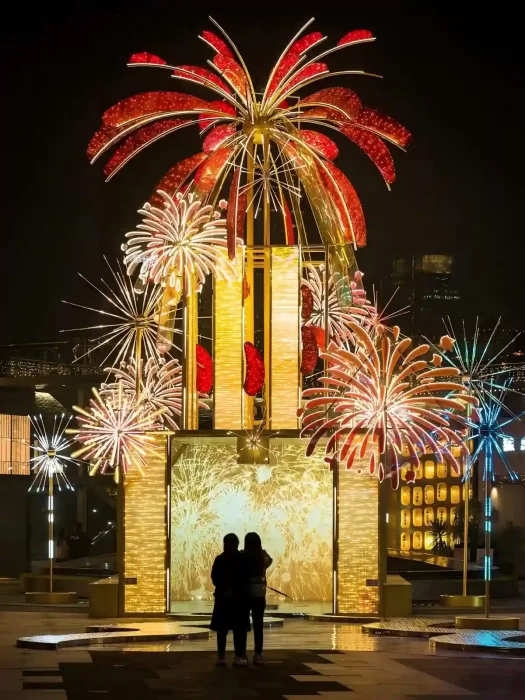
Large Commercial Outdoor Firework Lights for Plaza Facades
What IP65 Actually Means for Outdoor Firework Lights
The IP65 designation follows IEC standard 60529 and breaks into two digits: the first “6” confirms complete protection against dust ingress; the second “5” confirms protection against water jets from any direction, delivered through a 6.3 mm nozzle. For street-pole installations, building facades, shopping centre perimeters, and open plazas, an IP65-rated product handles standard seasonal rain, wind-driven moisture, and dust accumulation without permitting ingress that would degrade the LED driver or internal wiring.
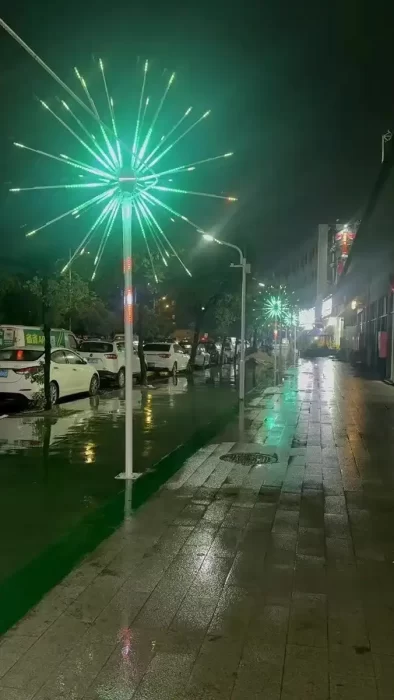
IP65 Outdoor Firework Lights on Rainy Street Poles
This matters practically for project procurement. IP65 suits the majority of commercial outdoor positions — open streets, retail frontages, park structures, building exteriors. It does not cover sustained high-pressure spray or persistent pooling water. IP66 suits coastal sites with persistent horizontal wind-driven rain, rooftop positions, or any fixture subject to periodic pressure washing. The practical difference: IP66 raises water-jet resistance from a 6.3 mm nozzle to a 12.5 mm nozzle at higher pressure — meaningful in exposed environments.
The most common procurement error is applying IP65 as a blanket standard across an entire site without reviewing individual mounting positions. Ground-level elements in zones prone to pooling water need IP67 rating; exposed coastal facades warrant IP66. For the bulk of municipal parks, commercial street poles, and building facades in temperate climates, IP65-rated LED firework lights are the correct specification.
IP Rating Quick Reference for Installation Positions
| Installation Position | Recommended Rating | Notes |
|---|---|---|
| Street poles, open plaza | IP65 | Standard outdoor specification |
| Building facades, retail frontages | IP65 | Adequate for most climates |
| Coastal sites, rooftop | IP66 | Horizontal rain and pressure-wash exposure |
| Ground-level or recessed | IP67 | Water pooling risk |
Commercial Sizing: Matching Firework Light Diameter to the Space
Manufacturers produce commercial LED firework lights outdoor in graduated sizes that correspond to the visual scale of the installation zone. These firework lights come in 2 m, 3 m, 4 m, and 5 m sizes. The 2 m and 3 m versions suit yard decoration, while 4 m and 5 m units serve park and street projects.
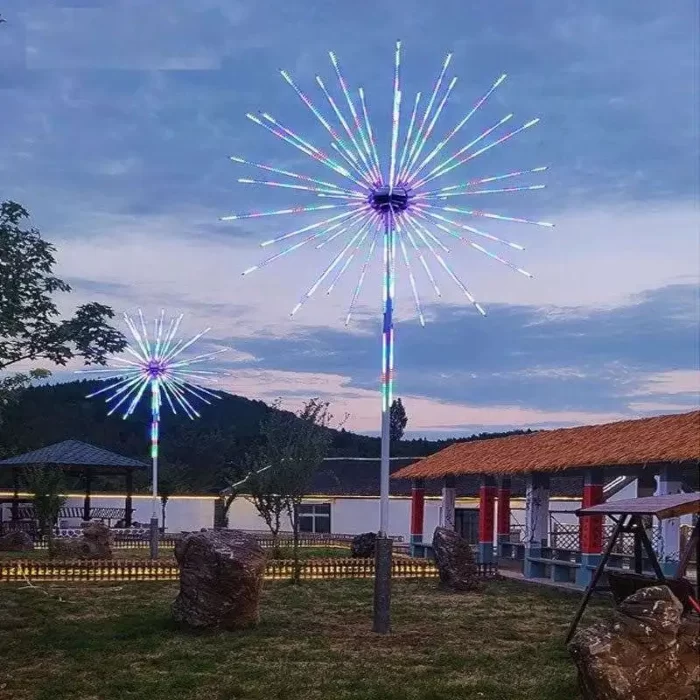
Large LED Firework Lights for Parks and Scenic Areas
Choosing the Right Size for Your Sightline
The sizing logic follows a straightforward rule: the firework diameter should read legibly at the viewer’s maximum sightline distance. For a pedestrian street with 6 m–8 m pole spacing, a 3 m unit mounted at 5 m–6 m height produces the intended bloom effect. For open plazas where the audience stands 30 m–50 m away — theme park entry zones, civic squares, commercial boulevard median strips — 4 m and 5 m units are standard.
Wattage, Lifespan, and Control Options
Wattage scales with size. Most commercial units in the 3 m–5 m range draw 80 W–120 W per fixture. LED fixtures run for 50,000 to 100,000 hours, compared to 15,000 hours for metal halide. This eliminates bulb and ballast replacements during operational life, removing costly maintenance calls that require lifts or bucket trucks. For a 40-unit street installation, that lifecycle difference translates to real operational savings — no cherry-picker callouts mid-season to replace blown lamps.
RGB color output with programmable dynamic effects — chasing, fading, strobing, static color holds — is standard on commercial units. DMX compatibility on higher-specification fixtures lets integrators synchronize multiple units across a facade or streetscape from a single controller. This enables coordinated seasonal playlist changes without re-rigging.
Installation Methods for Firework Lights Outdoor Commercial Projects
The four main mounting approaches for outdoor LED firework lights are pole mounting, tree mounting, facade/truss mounting, and freestanding ground-base mounting. Each carries different structural, electrical, and access requirements.
Pole and Street Mounting
Pole mounting is the most common configuration for municipal streetscaping and commercial boulevard projects. Installers must follow local electrical codes — including grounding and bonding requirements — to prevent electrical hazards. Proper installation ensures both stability and longevity.
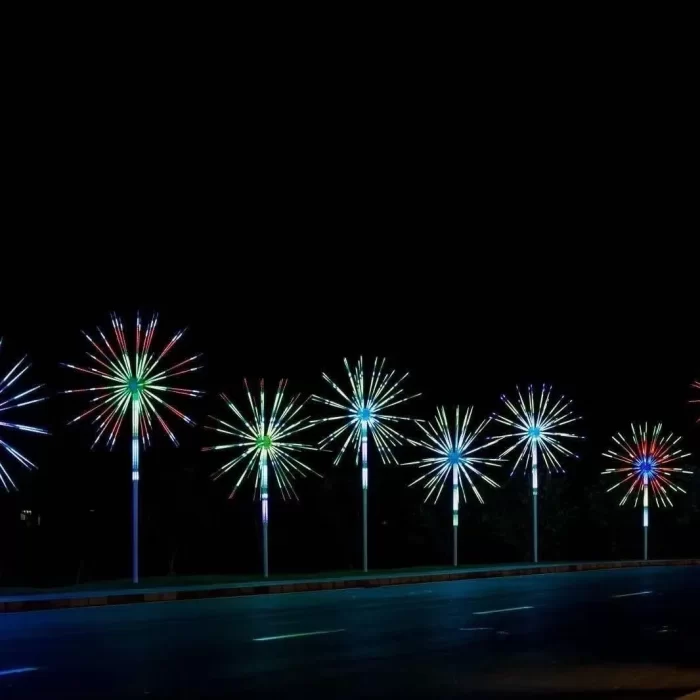
Pole Mounted RGB Outdoor Firework Lights for Streets
For existing street poles, a bracket arm at the specified height accepts the firework unit’s mounting collar. The critical engineering check is wind load: a 4 m–5 m spherical firework fixture presents a large surface area. Manufacturers publish IES files and wind-load data sheets; review these against local wind speed requirements before specifying pole hardware. Low-voltage operation — most commercial units run on 24 V DC or 220–240 V AC with integral drivers — simplifies cable management through existing pole conduit.
Tree and Canopy Mounting
For tree mounting, use adjustable tree straps — never nails or screws. Wrap straps around sturdy branches that can handle both weight and wind load. In practice, branches of 80 mm diameter or larger are the minimum for a 3 m firework unit. Distribute load across multiple attachment points rather than concentrating stress at a single junction. Seal junction points and cable connectors with self-amalgamating tape or IP-rated junction boxes to maintain the fixture’s ingress protection rating through the mounting hardware.
For mature specimen trees in parks or hospitality environments, a steel cable suspension system rigged between two anchor points — rather than direct branch attachment — distributes weight more evenly and avoids cambium damage.
Facade and Truss Mounting
For building mounting, install brackets on exterior walls using weather-resistant fasteners. On commercial facades — retail frontages, hotel exteriors, theme park structures — mount firework units on horizontal projecting arms anchored to masonry or structural steel. The arm length determines the standoff distance from the building face, which affects how the bloom reads against the architecture.
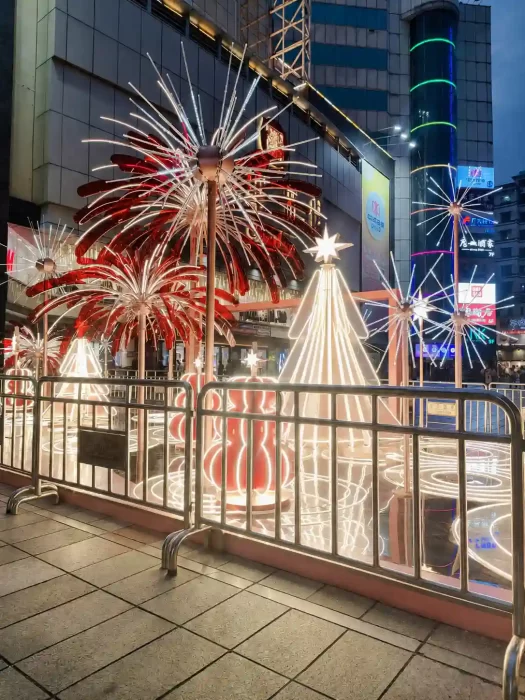
Outdoor Firework Lights for Retail Facades and Shopping Streets
Atrium and indoor event spaces use truss grid mounting. The low-voltage, non-pyrotechnic nature of LED firework lights makes them compatible with standard theatrical rigging practices. Foldable packaging on most commercial units reduces freight volume and simplifies hoist loading.
Freestanding Ground Base
For temporary event deployments or park installations where cable runs are impractical, weighted ground bases and stake mounts position units on open terrain. This approach suits seasonal activations — holiday markets, temporary park displays, event perimeters — where installers remove and store the units between seasons. The reusability advantage over pyrotechnic fireworks is material here: the same units deploy year after year without consumable cost.
[Figure 1: Installation method comparison diagram — pole, tree, facade, and freestanding configurations with recommended fixture sizes]
Solar Firework Lights Outdoor: Scope and Limitations
Solar firework lights outdoor occupy a distinct product category from the mains-powered commercial units described above. They suit low-load residential and light-commercial applications — garden paths, small hospitality terraces, residential entry markers — where grid connection is impractical and the viewing distance is under 10 m.
The key technical limitation is runtime consistency. Solar-charged units typically deliver 8–12 hours of operation following a 6–8 hour charge cycle, which is weather-dependent. In northern latitudes during winter months — precisely when seasonal lighting demand peaks — charge cycles shorten and runtime becomes unreliable. A municipal park installation expected to operate reliably from November through January needs more than solar firework lights outdoor can offer.
For commercial street and facade projects, solar options also fall short on lumen output and RGB programming depth. They lack DMX capability and cannot synchronize across large installations. The correct use case for solar firework lights outdoor is supplementary decorative lighting in locations where running mains cable is cost-prohibitive and consistent nightly runtime is not a contractual requirement.
Where a project specifies solar explicitly for sustainability or infrastructure reasons, the practical workaround is a hybrid approach: mains-powered LED firework lights on primary focal points (entrance gates, main streetscape poles), solar-powered accent units on secondary positions (pathway edges, tree bases).
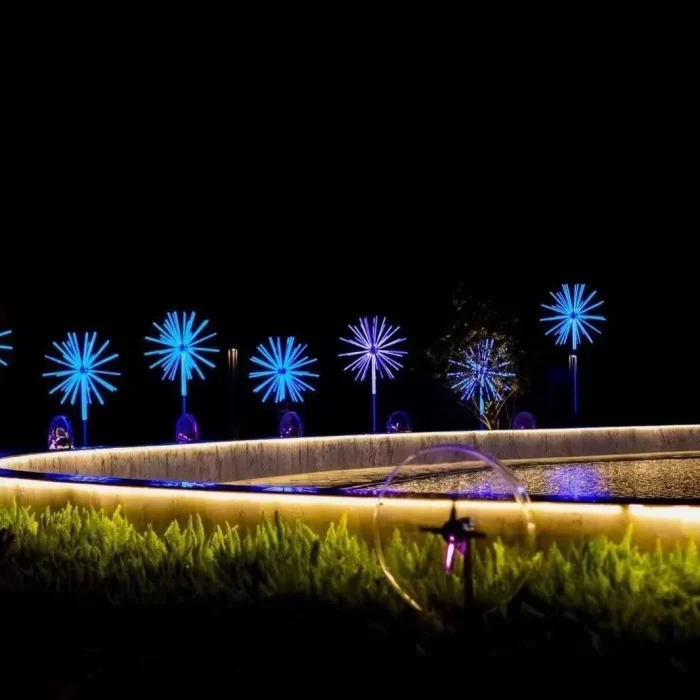
Solar Firework Lights for Pathway and Landscape Accent Lighting
Structural Hardware and Corrosion Resistance
The longevity of an outdoor firework light installation depends as much on the hardware as on the fixture itself. Strong iron poles support these light fireworks. Manufacturers powder coat all iron poles to resist rust. Compared with spray painting, powder coating lasts much longer and prevents the iron from rusting for a long time.
For coastal or high-humidity environments, the bracket and mounting hardware specification needs separate attention. On sites with salt air, humidity, or chemical exposure, the 316L stainless steel series offers superior corrosion resistance. The marine-grade alloy resists oxidation and pitting from salt spray. This extends service life in coastal resorts, marinas, docks, and industrial plants near water, where powder-coated aluminum or standard steel would show corrosion within 2–3 years in aggressive marine environments.
The fixture housing itself on commercial LED firework lights typically combines an iron or steel core with polypropylene tubes housing the LED branches. This combination keeps the unit light enough for manageable rigging while maintaining structural integrity under wind load. Confirm that the fixture’s stated IP65 rating applies to the complete assembly — housing, driver, and cable entry points — not just the outer shell.
Compliance Documentation for Municipal and Commercial Projects
Public-space installations involving electrical fixtures typically require compliance documentation during project approval. The relevant certifications for outdoor LED firework lights include CE marking, RoHS conformity, and — for specific markets — UL or ETL listing.
CE marking is the market access declaration confirming a product meets all applicable EU directives. RoHS is one of those directives — specifically governing restricted hazardous substances. Since the EU reclassified RoHS 2 as a CE Marking Directive, the two are legally connected: RoHS conformity is a prerequisite for CE marking on covered products.
For municipal procurement, request the following documentation at the quote stage to avoid delays at approval: IES photometric files (for photometric plan verification), ISO 9001 manufacturing certification, CE/RoHS compliance reports, and a technical drawing package. Most commercial manufacturers can provide these within 24 hours of a B2B inquiry. Confirm that any unit specified as non-pyrotechnic carries an explicit declaration to that effect — important for public venue permitting where pyrotechnic regulations apply.
[Figure 2: Compliance document checklist for commercial outdoor LED firework light procurement]
Frequently Asked Questions
Are IP65 Firework Lights Outdoor Suitable for Year-Round Installation in Rainy Climates?
IP65 is the correct rating for year-round outdoor installation in most temperate climates, including regions with significant seasonal rainfall. The rating confirms protection against water jets from any direction, covering standard precipitation including heavy rain and wind-driven moisture. One qualification applies to installation position: fixtures at ground level in areas prone to pooling water need IP67, and coastal sites with persistent horizontal rain warrant IP66. For street poles, park structures, and building facades in non-coastal locations, IP65 LED firework lights operate reliably through the full year without additional weatherproofing.
What Is the Voltage Requirement for Commercial Outdoor Firework Lights?
Most commercial LED firework lights outdoor run on 220–240 V AC with an integral driver that converts to the low-voltage DC supply the LEDs require. Some product ranges accept 24 V DC input directly, making them compatible with low-voltage landscape lighting infrastructure. Low-voltage operation reduces rigging hazards for elevated installations — particularly on pole mounts and facade brackets — and simplifies compliance with local electrical codes in public spaces. Confirm the input voltage specification with the manufacturer at the quote stage, as it affects cable sizing, transformer requirements, and installation cost.
Can Outdoor LED Firework Lights Be Reused Across Multiple Seasons?
Yes — reusability across seasons is one of the primary operational advantages of LED firework lights over pyrotechnic alternatives. Commercial units with powder-coated steel hardware and IP65-rated housings are built for multiple deployment cycles. The correct procedure is to inspect and seal cable entry points at each reinstallation, check mounting hardware for corrosion, and store units in foldable manufacturer packaging to protect LED branches during transport. Most commercial fixtures carry a 3–5 year manufacturer warranty covering multiple seasons of use.
Do Outdoor Firework Lights Work with DMX Controllers for Synchronized Displays?
Higher-specification commercial LED firework lights include DMX512 input, which allows multiple units to address and synchronize from a single controller. This is standard practice for facade installations and streetscape projects where coordinated color sequences and dynamic effects form part of the design brief. Entry-level commercial units typically use simpler RF or push-button control systems that offer preset modes without individual unit addressability. For any project requiring synchronized effects across 10 or more fixtures, specify DMX compatibility explicitly in the procurement brief.
A Note on Specification Accuracy
One consistent issue in commercial firework light procurement is the gap between catalog IP ratings and actual installed performance. The IP65 rating applies to the complete fixture as tested — but the installation maintains that rating only when cable glands, junction boxes, and mounting hardware match the same ingress protection level. A fixture rated IP65 connected through an unrated junction box drops to the weaker protection level of that box.
For high-value installations — civic squares, theme park perimeters, hotel facades — run a site-specific IP audit of every connection point in the cable run before commissioning. The fixture itself is only as weatherproof as its weakest connection.