
Firework Christmas Lights for Malls, Streets & Hotels
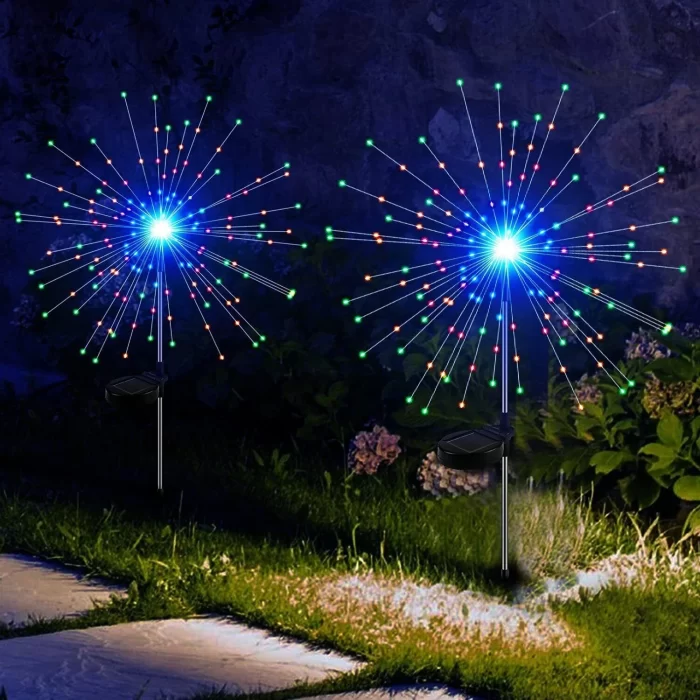
Solar Firework Christmas Lights for Outdoor Holiday Displays
Firework Christmas lights are LED starburst and burst-effect decorations designed to simulate the visual of an exploding firework. In commercial settings — malls, street corridors, hotel facades, and atriums — they function as focal-point elements within larger holiday lighting programs, adding height, movement, and layered depth that flat string lighting cannot achieve on its own.
Also referred to as fireworks xmas lights, starburst lights, or polestar lights, these fixtures are available in sizes from 30 cm pendant heads to ground-mounted animated displays reaching 8 feet or more, and they are rated for outdoor use at IP44 to IP65 depending on application.
What Firework Christmas Lights Are — and Why Commercial Buyers Specify Them
At the product level, a firework Christmas light consists of radial wire or fiber arms extending from a central hub, each tipped with an LED cluster. When lit, the result reads as a burst of light from a fixed point — a firework frozen mid-explosion.
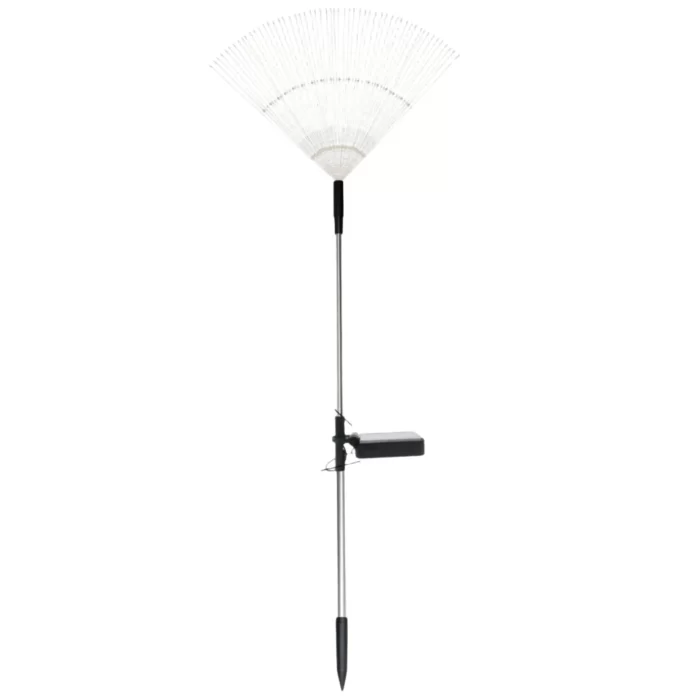
Solar Firework Christmas Light Product Structure
What separates commercial-grade fireworks christmas lights from consumer versions is the construction layer beneath that visual effect. Commercial fixtures use powder-coated steel or reinforced PVC frames, heavier-gauge wiring, and LEDs rated for 50,000+ hours of operation. IP65-rated units handle rain and temperature swings across full outdoor seasons; IP44-rated units suit covered atriums and interior-facing facades. RGB-capable heads allow color temperature to be adjusted or animated without hardware changes — a specification that matters for properties running coordinated lighting control systems.
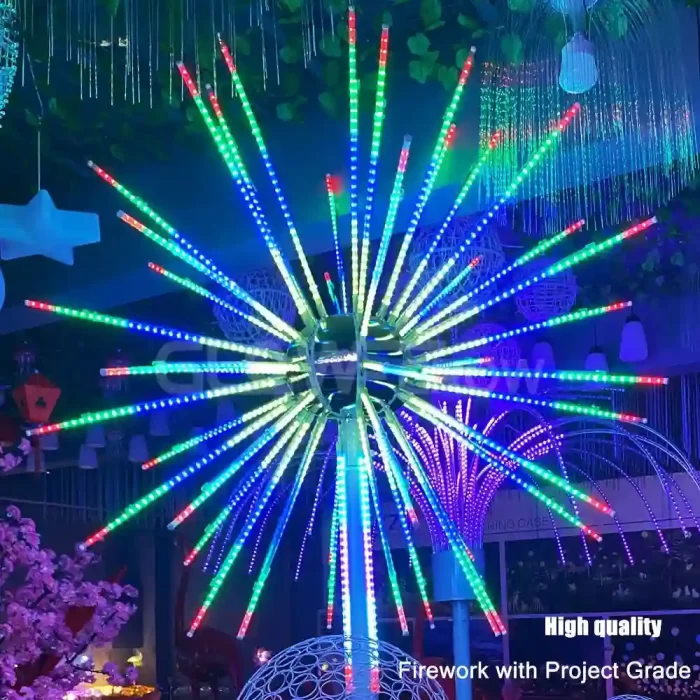
Commercial Grade Firework Christmas Lights for Large Displays
The case for including firework xmas lights in a commercial display program comes down to visual layering. String lights and garland create horizontal planes of light. Motif pole mounts operate at lamppost height. Firework lights introduce a third layer — radial bursts at variable heights — that fills the visual space between ground-level elements and overhead canopy lighting. In large spaces like mall atriums or open street corridors, that vertical fill is what makes a display read as intentional rather than sparse.
Application Zones: Matching Firework Light Format to Venue Type
Different venue types call for different firework light formats, mounting methods, and size ranges. What works in a hotel lobby does not automatically translate to an outdoor street installation, and specifying the wrong format creates both installation problems and visual mismatches.
Mall Atriums and Interior Retail Corridors
Atrium installations typically suspend firework pendant clusters from structural rigging points in the ceiling. The goal is to create a constellation of burst points at varying drop heights, so that shoppers moving through the space experience the display from multiple angles.
For high-ceiling atriums, pendant heads in the 40–80 cm range read well from below without dominating sight lines. Lower-ceiling corridors — department store walkways, food court approaches — call for smaller 20–30 cm heads to maintain clearance. RGB control allows the atrium display to shift color temperature throughout the trading day: warm white during standard hours, dynamic color for evening events.
Retail corridors benefit from firework starburst lights paired with overhead string canopies. The starbursts anchor key sightline points — ends of corridors, above escalators, at major tenant entrances — while string lighting fills the field between them.
Street and Streetscape Installations
Street applications for fireworks christmas lights divide into two formats: pole-mounted starbursts and overhead cross-street suspensions.
Pole-mounted units attach directly to lampposts or dedicated lighting columns along a street corridor. Sizes in the 60–120 cm range are standard for street poles, sized so the burst is visible from a moving vehicle but does not extend into traffic clearance zones. Hardware typically includes saddle clamps or banded brackets designed for standard pole diameters.
Cross-street suspensions string firework heads on catenaries spanning the road. This format requires structural assessment of anchor points on both sides — building facades, purpose-built poles, or utility mounts — and needs wind-load calculations for the selected display size. For high-wind locations, slimmer-profile starburst heads reduce drag compared to full spherical burst designs.
Municipal projects that pair fireworks xmas lights with pole-mounted snowflakes or wreaths get a layered streetscape: motif elements at lamppost height, starburst bursts at mid-span, and overhead canopy lighting creating a ceiling over the whole corridor.
Hotel Facades and Entrance Zones
Hotel applications split between the entrance approach — porte-cochère columns, driveway flanking, planted areas — and the building facade itself.
Entrance columns are strong mounting points for mid-size firework starburst clusters, typically 50–80 cm, either single units or grouped in threes at varying heights. The entrance is the first and last impression guests receive, and burst-effect lighting at this scale reads as deliberate luxury without requiring the infrastructure of a full facade installation.
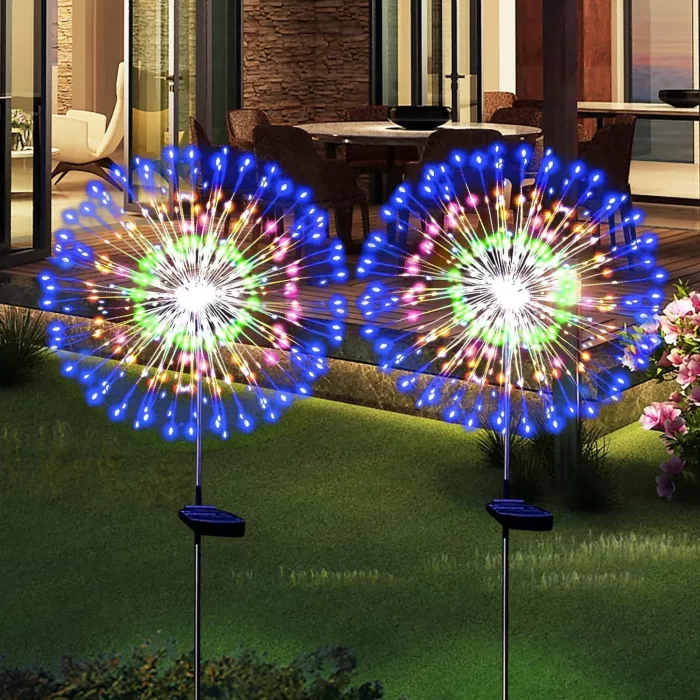
Firework Starburst Lights for Entrance and Landscape Displays
Facade installations use the building’s exterior architecture as the mounting substrate. Window surrounds, cornice lines, and balcony railings provide attachment points for string firework lights and smaller starburst units. The visual goal is to echo the building’s geometry with light — outlining what already exists rather than superimposing a separate lighting layer on top of it.
Hotel lobby atriums follow the same logic as mall atriums, with the added consideration that hotel displays often need to work at lower light levels in the evening to maintain atmosphere. Dimmable LED drivers on firework xmas lights preserve design flexibility here.
Christmas Tree Integration: Firework Lights as Canopy Fill
One of the highest-impact uses of fireworks christmas lights in commercial displays is within large-format Christmas trees. Trees from 20 to 80 feet — the scale common in mall courts, hotel lobbies, and civic plazas — have significant interior volume that standard wrapped string lights cannot fully illuminate from the outside.
Inserting starburst firework units at mid-depth within the tree canopy creates an interior glow that reads from all viewing angles. The burst effect visible through the outer branches gives the tree a lit-from-within quality that flat wrapping does not achieve. Starburst heads in warm white or gold work within the tree’s existing color palette; RGB units allow the tree’s interior lighting to sync with the surrounding display program.
Practically, tree integration requires firework starburst lights with longer lead cords to reach power from the tree base, and mounting attachments compatible with the tree’s internal frame. Commercial tree suppliers and firework light manufacturers increasingly coordinate on this — it is worth confirming compatibility before ordering at scale.
Technical Specifications: What to Confirm Before Ordering
Commercial procurement for firework Christmas lights requires confirming a specific set of specifications that consumer product listings often omit or understate.
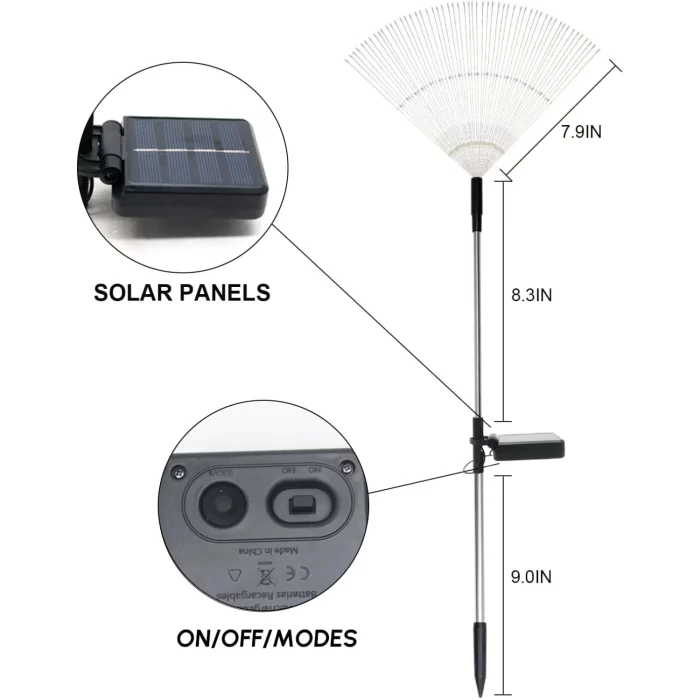
Firework Christmas Light Specifications and Solar Panel Details
IP Rating is the starting point for any outdoor application. IP65 is the minimum for fully exposed street and facade installations — it confirms protection against water jets from any direction. IP44 suits covered installations where direct rain exposure is not a factor: hotel entrance canopies, covered walkways, interior atriums. Mixing IP ratings across a single display zone creates maintenance inconsistency, since some units will degrade faster than others.
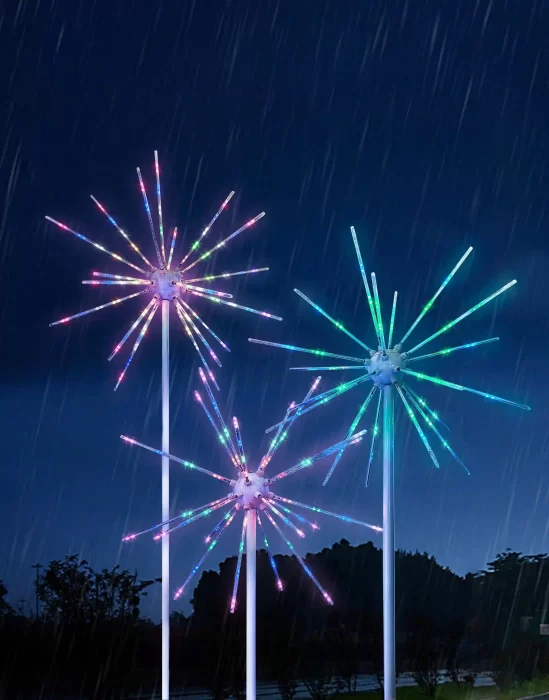
Weather Resistant Outdoor Firework Christmas Lights
Frame material and finish determines multi-season durability. Powder-coated steel resists corrosion in wet climates; stainless hardware on mounting points avoids rust staining on facades. PVC-frame units are lighter and suit interior applications where structural load is a concern.
Control compatibility is increasingly relevant as commercial properties move toward programmatic lighting control. Firework lights with DMX-compatible or smart LED drivers can be integrated into existing control infrastructure; those without require separate timers and cannot participate in animated sequences. For venues with existing lighting control infrastructure, animated motifs can often integrate directly; for those without, the control layer is typically the larger cost and lead-time item — worth budgeting separately.
Voltage and power draw determines circuit planning. A 30-unit starburst installation across a street corridor needs a load calculation before the first fixture ships. Commercial-grade firework lights typically run at 110–240V input with individual unit draws in the 10–80W range depending on size and LED count. Confirming wattage per unit and total zone draw against available circuit capacity prevents installation-day problems.
Lead cord length matters more in commercial applications than product listings suggest. Tree integrations, facade runs, and tall pole mounts all require longer leads than pendant applications. Confirm available lead lengths or custom cord options before finalizing orders.
Seasonal Procurement: The Commercial Buying Timeline
Commercial holiday lighting procurement operates on a calendar that is months ahead of consumer retail. The gap exists because custom and large-scale firework christmas light orders carry significant lead times, and because commercial properties need installation windows that are tightly constrained by operations — stores cannot close, guests cannot be displaced, streets cannot be blocked at peak trading hours.
Municipalities and commercial buyers should plan to pre-order in spring or early summer. Depending on the type of product — especially custom or large-scale décor — lead times can range from 12 to 14 weeks. For standard catalog firework starburst units, lead times are shorter, but popular sizes and RGB configurations sell out early in the pre-season period.
Commercial buyers who complete major orders before October avoid sell-outs and capture early-bird pricing. Post-Christmas clearance — from December 26 through January — delivers the lowest prices of the year for stocking the following season.
A practical procurement calendar for a commercial firework Christmas lights program:
- February–March: Assess prior season inventory. Identify what requires replacement, addition, or upgrade. Begin vendor conversations for custom or large-format pieces.
- April–June: Finalize specifications and place orders. This window captures pre-season pricing and accommodates 12–14 week production lead times on custom units.
- July–August: Receive and inspect inventory. Confirm all units are operational before storage. Identify any shortfalls while time remains to reorder.
- September–October: Finalize installation design and crew scheduling. Arrange lift equipment and access permits for street or facade work.
- November: Installation window opens. Commercial properties typically install before peak trading begins — US shopping centers often require night installations to avoid disrupting daytime foot traffic.
- December 26–January: Teardown, inventory audit, and next-season procurement planning.
A disciplined teardown process — removing and labeling strands by zone or building section, coiling and storing in waterproof containers, documenting materials needing repair — reduces next year’s setup time by up to 25% and extends equipment life.
Display Design Principles for Large-Scale Firework Light Programs
Effective commercial firework christmas light displays follow a tiered structure rather than treating the entire installation as a single uniform layer.
Anchor points establish the display’s primary focal moments — the entrance, the atrium centrepiece, the midpoint of a street corridor. These receive the largest or most complex firework starburst configurations, potentially animated or RGB-capable units.
Field elements fill the space between anchor points. Smaller pendant starburst heads, firework string lights, or simpler static burst units maintain the visual language at lower intensity across the full installation area. The field supports the anchor points without competing with them.
Transition elements — garland, string canopies, motif pole mounts — connect zones and provide the background against which firework lights read. A starburst pendant in open air competes with ambient light and architectural elements; the same unit against a backdrop of warm white string canopy reads cleanly.
Single-temperature white has become the default choice in premium retail, hospitality, and civic contexts. Warm white tends to suit aspirational contexts — high-street fashion precincts, hotel forecourts, fine dining districts. Cool white leads in contemporary civic spaces, technology campuses, and venues pursuing a crisper, more Nordic register.
For properties running programmatic evening lighting, fireworks xmas lights that synchronize color transitions with the wider display create the most coherent guest experience. The effect — burst units and canopy lighting shifting together — reads as a single designed show rather than separate product categories running independently.
Pairing Firework Christmas Lights with Complementary Products
A firework christmas light program works best when specified alongside compatible product categories rather than as a standalone addition to an otherwise complete display.
Motif lights — two-dimensional or three-dimensional holiday figures on pole mounts — operate at street and corridor height. Firework starbursts mounted above or between motif positions add a layer that motif lights alone cannot provide. The pairing is standard practice in streetscape programs.
String lights and canopy lights provide the background field that makes firework starburst elements readable. Without that backdrop, burst-effect lights can feel isolated rather than embedded in a coherent display.
Meteor lights and snowfall tubes create a downward-movement effect that contrasts with the outward-burst reading of firework lights. Used together — snowfall tubes on vertical surfaces, firework lights as point anchors in trees or at structural joints — the combination covers multiple visual directions within one display.
Large-format Christmas trees work as a structural host for firework starburst integration, as covered above. A tree with interior firework lights embedded in its canopy becomes a display centrepiece that justifies its floor plan footprint in a mall court or hotel lobby.
Frequently Asked Questions
What is the difference between firework christmas lights and standard starburst lights?
The terms are used interchangeably in commercial lighting. Starburst lights, polestar lights, and firework lights all describe the same product category: radial-arm LED fixtures that produce a burst-of-light effect. Animated or RGB-capable versions that cycle through color or intensity patterns are sometimes marketed specifically as “firework” lights to emphasize the motion quality, but the underlying product structure is the same.
What IP rating do firework christmas lights need for outdoor commercial use?
IP65 is the standard minimum for exposed outdoor installations — street poles, open facades, tree canopies exposed to weather. IP44 is acceptable for covered environments: hotel entrance canopies, covered walkways, atrium installations where rain exposure is indirect. Confirm the installation environment before specifying, since IP ratings affect both pricing and multi-season durability.
How far in advance should commercial buyers order firework christmas lights?
For standard catalog units, ordering by August ensures availability for November installation windows. For custom sizes, RGB configurations, or large-format ground-mounted displays, allow 12–14 weeks from order to delivery — which means placing orders by June or July to install before peak trading season.
Can firework christmas lights be integrated into existing lighting control systems?
Units with DMX-compatible or smart LED drivers can integrate into building management or programmatic lighting control systems. Standard units with fixed LED drivers require separate timer controls and cannot participate in synchronized animation programs. Confirm control compatibility with the supplier before ordering for a property that has existing control infrastructure.
Procurement teams working on Christmas season projects for the first time often underestimate how much of the outcome is decided before a single fixture ships — in the specification detail, the timing of orders, and the way individual product categories are designed to work together rather than alongside each other. Fireworks christmas lights are a high-impact element in a well-composed display, and they perform best when the supporting layers — string canopies, motif pole mounts, anchor trees — are specified with the same intention.