How to Verify a Decorative Lights Manufacturer in China Before a Bulk Order
To verify a lighting manufacturer in China before a bulk order, start with company records, production evidence, and product tests—not just a polished website or a low quotation. A reliable supplier should be able to explain who makes your lights, which standards apply, how quality checks work, and what happens if a batch fails inspection.
This matters when sourcing LED string lights, Christmas decorations, 2D and 3D motif lights, LED trees, and custom outdoor displays. These products may use different wires, connectors, controllers, frames, and waterproofing methods. A certificate or sample for one model does not automatically prove that another model meets the same requirements.
This guide provides a practical verification process for buyers preparing to place a large order. If you are still comparing suppliers, read our guide to choosing a decorative lights manufacturer. This article focuses on verifying company identity, product compliance, production capability, and order fulfillment before payment.
1. Verify the Company and Factory
Start with the legal entity, then confirm where production takes place and who takes responsibility for your order. A registered business does not automatically prove that it owns or operates a manufacturing facility.

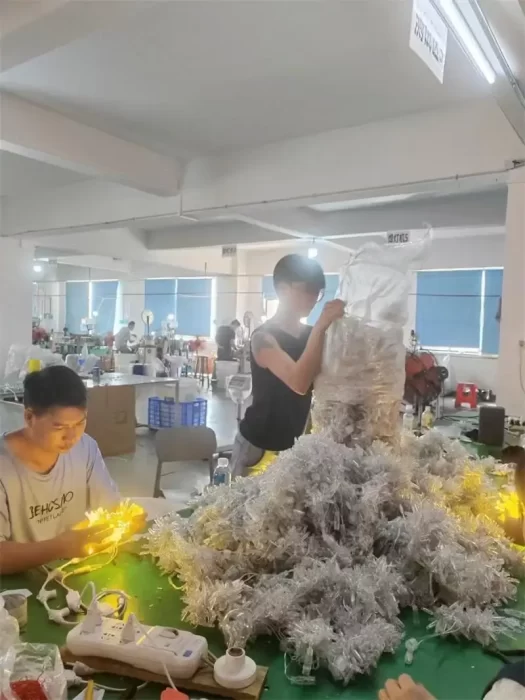
Yaoyu Decorative LED lights manufacturing line with workers assembling string lights and motif frames
Check the Business Registration
Ask the supplier for a readable copy of its business license. Check the following details:
- Full legal company name in Chinese.
- Unified Social Credit Code.
- Registered address and business status.
- Legal representative and registered business scope.
- Actual production address, if it differs from the registered address.
Next, search the company name or registration code through China’s National Enterprise Credit Information Publicity System.
Compare the registration details with the sales contract, quotation, commercial invoice, and proposed payment beneficiary. If different companies appear on these documents, ask why. An export agent or manufacturing partner may be legitimate, but the relationship and responsibilities should be clear before you order.
Shinesall’s About Us page identifies Hangzhou Yaoyu Optoelectronic Co., Ltd. and provides a Hangzhou address. Buyers should treat this public information as a starting point and confirm the legal entity and production-site details relevant to their order.
Confirm That the Factory Exists
Ask the supplier to explain whether it produces goods in-house, uses a contracted factory, or combines both arrangements. A live video tour can help you check the answer.
During the tour, request a view of the following areas:
- Raw materials and component storage.
- Wire processing and LED assembly.
- Frame fabrication for 2D or 3D motif lights, where applicable.
- Soldering, wiring, and waterproofing stations.
- Quality inspection and aging-test areas.
- Finished goods, packing stations, and the warehouse.
Ask the supplier to show a product similar to your planned order. A general showroom tour provides less evidence than a walkthrough of the relevant production and testing areas.
Compare the stated production capacity with the equipment, staffing, work schedule, and recent production records. If the supplier outsources frame fabrication, controller assembly, or other key processes, ask how it manages those suppliers.
2. Check Product-Specific Certifications
Do not accept a list of certification logos as proof of compliance. First, identify the requirements for your exact product and destination market. Then verify the supporting documents.
Match Each Certificate to the Product
Request readable copies of relevant certificates, test reports, declarations, and audit documents. For each document, check:
- Certificate or report number.
- Issuing organization and its relevant accreditation or recognition.
- Legal name of the certificate holder.
- Covered product models and components.
- Applicable standards and test scope.
- Issue date, validity status, and any limitations.
- Whether the document covers the configuration you plan to purchase.
Pay particular attention to changes in the LED source, power supply, controller, wiring, connector, or enclosure. These changes may affect the evidence needed to support compliance.
Check Requirements for Your Destination Market
| Market or Requirement | Evidence to Request | What to Verify |
|---|---|---|
| EU/EEA | Applicable conformity documents, EU Declaration of Conformity, and supporting technical or test records | Product scope, applicable legislation, model, and configuration |
| United States | Relevant UL, ETL, or other applicable NRTL certification or listing, where required | Product category, standard, certification holder, and current listing status |
| Outdoor Decorative Lights | Relevant ingress-protection test report, where an IP rating is claimed | Exact model, tested configuration, and test conditions |
| Restricted Substances | Applicable RoHS or other chemical-compliance documentation | Product or material scope and destination-market requirements |
| Factory Quality Management | ISO 9001 certificate, if claimed | Certificate holder, validity, and certified business scope |
These are verification starting points, not a universal list of mandatory certificates. Requirements depend on the product, its intended use, its electrical configuration, and the destination market.
For example, the European Commission’s CE-marking guidance explains that CE marking applies when relevant EU rules require it. Manufacturers must identify the applicable rules and prepare the required conformity documentation. CE is not a universal certificate issued by one central EU authority.
Similarly, the US Occupational Safety and Health Administration’s NRTL program covers recognized testing and certification organizations within defined scopes. Do not assume every decorative light requires the same US certification. Confirm the applicable requirements for the product, intended use, and sales channel.
An ISO 9001 certificate supports a claim about quality management. It does not, by itself, prove that a specific LED string light or outdoor motif light meets applicable electrical safety or weather-resistance requirements.
The key rule is simple: verify the document, the product, the standard, and the market together.
3. Review Samples and QC Records
A good sample is a useful starting point, but it cannot prove that a factory will reproduce the same result across hundreds or thousands of units. You need both a controlled sample-approval process and evidence of repeatable quality checks.
Quality inspection and electrical testing of decorative LED lights before bulk shipment
Compare the Sample with Your Purchase Specification
Before approval, record the details that matter to your product:
- Dimensions, design, frame material, and finish.
- LED type, color, brightness, and lighting effects.
- Input voltage, rated power, wire type, and cable length.
- Connectors, controller functions, and accessories.
- Claimed IP rating and relevant construction details.
- Labels, warning information, and retail packaging.
Test the sample against your written specification. A decorative light may look correct but use a different controller, shorter cable, thinner frame, or different connector from the quoted model.
Once you approve the sample, keep a dated reference sample or a clear, signed specification record. The purchase order should identify the approved version and prohibit unapproved substitutions.
Ask for Actual Quality-Control Records
A description of a quality-control process is not the same as proof that the supplier performed the checks. Request an anonymized record from a real production batch of the same or a closely comparable product.
| Record Field | What to Look For |
|---|---|
| Product and Batch ID | A clear link to the model and production lot. |
| Inspection Date | When the check took place. |
| Test or Inspection Item | Appearance, dimensions, electrical function, or other relevant checks. |
| Acceptance Criteria | The specification or limit used to judge the result. |
| Sample Size and Results | The number checked and the recorded findings. |
| Inspector and Disposition | Who checked the goods and what happened to any failures. |
Ask how the supplier handles defects. Does it isolate failed units, investigate the cause, rework or replace products, and record the result? A clear corrective-action process provides more useful evidence than a claim of “strict quality control.”
Check Quality at Several Stages
- Incoming inspection: Check wires, LEDs, connectors, frames, and other components against the approved specification.
- In-process inspection: Check assembly, soldering, wiring, frame quality, and other product-specific steps.
- Functional and aging tests: Confirm that the lights operate as specified and follow the agreed test procedure.
- Environmental tests: Where applicable, check waterproofing or other environmental claims using appropriate methods.
- Pre-shipment inspection: Inspect the finished order against the agreed sampling plan and acceptance criteria.
Not every product requires the same tests. Define the inspection items, sample size, defect categories, and acceptance rules before production starts.
Review our production and quality-control process, then request the actual records relevant to your selected model.
4. Confirm Customization Capability
A supplier may offer OEM or ODM services without being able to manage every type of customization in-house. Verify the capabilities your project actually needs.
For custom motif lights, ask whether the supplier can work from drawings, reference images, or design files. Confirm the proposed dimensions, frame material, lighting layout, finish, mounting method, and controller requirements.
For customized string lights, confirm the LED colors, cable length, connector type, power supply, controller functions, and packaging requirements.
If your project involves outdoor installations, discuss the intended environment, mounting conditions, and relevant weather-resistance or structural requirements.
Follow a Clear Sample-Approval Process
- Submit the specification. Share drawings, reference photos, dimensions, target market, and performance requirements.
- Review the design. Confirm the proposed materials, electrical configuration, finish, and packaging.
- Approve the sample. Test the sample and record any changes.
- Freeze the specification. Keep the approved drawings, bill of materials, labels, and sample reference together.
- Approve production changes. Require written approval before the supplier changes a critical component or design.
- Inspect the bulk order. Compare production units with the approved sample and purchase specification.
Ask for realistic sample and production lead times. Also, confirm who owns custom artwork, engineering drawings, and tooling, especially when you commission an exclusive design.
The goal is not simply to see whether a supplier can make one attractive sample. It is to confirm that the supplier can reproduce the approved product consistently.
5. Check Packaging and Export Documents
Packaging problems can damage decorative lights before they reach your warehouse. Missing documents or inconsistent shipping details can also delay customs clearance and delivery.
Review the Packaging Specification
Before bulk production, confirm:
- Units per inner box and master carton.
- Carton dimensions, gross weight, and net weight.
- Protective materials for LEDs, frames, cables, and delicate parts.
- Product labels, barcodes, warning labels, and carton marks.
- Installation instructions and accessory lists.
- Pallet requirements and any special handling needs.
For large 3D motifs or commercial display lights, check how the supplier protects the frame and separates components during transport. If the product needs assembly at the destination, confirm that the package includes the correct hardware and instructions.
Ask for a packaging sample or photos of a completed packing trial. For fragile or high-value orders, consider a suitable packaging or transport test before approving the final design.
Confirm the Export Document Process
Ask who will prepare each document and who will act as the exporter of record, where relevant. Depending on the shipment and destination, the document set may include:
- Commercial invoice.
- Packing list.
- Bill of lading or air waybill.
- Certificate of origin, if required.
- Product compliance documents requested by the importer or market.
- Customs declaration or other shipping records, as applicable.
Check that the product descriptions, quantities, carton counts, legal entities, and shipping details match across the documents. Also, agree on the Incoterm, shipment date, destination, and responsibility for freight, customs clearance, and other charges.
Before production, ask for a draft packing list or a sample of the supplier’s usual shipping documents, with confidential customer details removed. This helps you identify process gaps before the goods are ready to ship.
6. Questions to Ask Before Paying a Deposit
Before releasing a deposit, ask the supplier these questions and keep the answers in writing.
Company and Production
- What is the full legal name of the company signing the contract?
- Where will this order be manufactured, and does the company use any production partners?
- Can you provide the relevant business and factory documents?
Certification and Quality
- Which certificates and test reports apply to this exact model and destination market?
- Can you provide readable copies and explain their scope?
- Can you share an anonymized QC record from a comparable production batch?
- What happens if the goods fail the agreed inspection?
Samples and Customization
- Which approved sample and specification will control bulk production?
- Can you confirm that no critical component will change without written approval?
- What are the sample, production, inspection, and shipment milestones?
Payment and Delivery
- Does the payment beneficiary match the contracting entity, or is there a documented reason for a different entity?
- What are the deposit, balance-payment, and inspection terms?
- Which packaging and export documents will you provide?
- Who pays for rework, replacement, or re-inspection if the order fails the agreed criteria?
A trustworthy supplier should be able to explain these points clearly. You do not need every answer to be complicated, but you should not have to rely on vague promises.
7. Red Flags in Supplier Claims
Pause the order and investigate further if you find any of these warning signs.
- Unclear company identity: The business license, contract, invoice, and payment details do not match, and the supplier cannot explain why.
- Unverified certifications: The supplier provides logos or generic PDFs but cannot identify the certificate holder, model scope, or relevant test reports.
- No clear production arrangement: The supplier claims to own a factory but refuses to identify the actual production site or explain subcontracting.
- No traceable QC evidence: The supplier describes strict inspections but cannot show dated records or explain the acceptance criteria.
- Sample and production differences: The supplier changes wires, controllers, materials, or other agreed components without approval.
- Unclear payment arrangements: The supplier requests payment to an unrelated personal account or refuses to document the transaction.
- Vague delivery terms: The supplier will not confirm packaging, lead times, inspection arrangements, or responsibility for defects in writing.
One warning sign does not automatically prove fraud. However, several unresolved issues should delay the deposit until you have enough evidence to make an informed decision.
8. Decorative Lights Manufacturer Verification Checklist
Use this interactive checklist before approving your first bulk order. Check each item as you complete the verification process.
Company and Factory Verification
Product Compliance and Quality Control
Customization, Packaging, and Shipping
Keep this checklist with your quotation, approved sample, purchase order, and inspection records.
Final Thoughts
To verify a lighting manufacturer in China, focus on evidence that connects the company, the factory, the approved product, and the final shipment. A business license establishes a starting point. Product-specific documents help you assess compliance. Samples and actual QC records help you judge production consistency. Clear packaging, export, and payment terms reduce avoidable risks.
No single certificate, factory video, or successful sample can guarantee a perfect order. However, a documented verification process gives you a much stronger basis for making a purchasing decision.
If you are reviewing Shinesall for a bulk order, request product and compliance documents. Share your product type, order quantity, destination market, and customization requirements so the team can identify which company, factory, certification, and quality records are relevant to your project.
Frequently Asked Questions
How can I verify a lighting manufacturer in China?
Check the legal entity through China’s official enterprise information system, confirm the actual production site, verify product-specific certificates, review a sample, and request traceable QC records. Before paying, confirm the contract, payment, inspection, and shipping terms in writing.
Which certifications should I check for decorative lights?
The requirements depend on the product, its electrical configuration, intended use, destination market, and sales channel. Ask for the applicable conformity documents and test reports rather than relying on a generic certificate list.
Is an ISO 9001 certificate enough to verify a lighting supplier?
No. ISO 9001 relates to quality management systems. It does not prove that a particular decorative light meets all applicable electrical safety, environmental, or product-performance requirements.
Should I arrange a factory audit before a bulk order?
A live video audit may help with an initial review. An on-site or independent third-party audit can provide stronger evidence when the order value, customization complexity, or potential loss justifies the cost. You should still check product samples, QC records, and contract terms.