
Solar Firework Lights for Outdoor Garden & Commercial Landscape Projects
Solar firework lights are ground-stake or pole-mounted decorative fixtures that use flexible LED-tipped copper wires to simulate the burst pattern of a firework explosion — powered entirely by a built-in photovoltaic panel and rechargeable battery. For landscape firms, hotel grounds teams, and park décor projects, they offer one practical advantage that wired alternatives cannot: installation requires no trenching, no licensed electrician, and no connection to mains power.
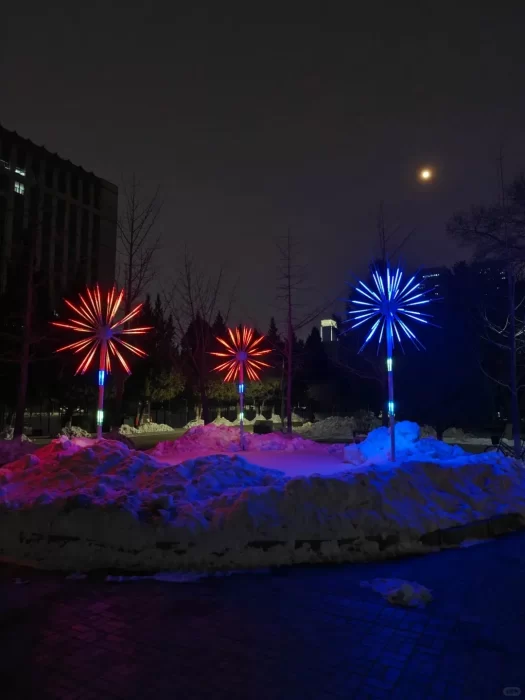
Firework Solar Lights for Commercial Landscape Displays
What Makes Solar Firework Lights Different from Standard Garden Solar Lights
Most solar garden lights — path stakes, bollards, wall-wash fixtures — produce a fixed beam aimed at a specific target. Solar firework lights work differently. The illumination source is a radial array of flexible copper wire branches, each tipped with multiple LED beads that extend outward from a central stake head. The effect is omni-directional ambient scatter rather than directional task lighting.
The LED Array Structure
Each fixture typically carries between 90 and 160 individual LED beads distributed across 20 to 40 copper wire strands. Because the wire is flexible, the array can be shaped before installation — spread wide for a full starburst, compressed into a tighter globe, or bent asymmetrically to follow a contour. This DIY-shaping characteristic is particularly useful on projects where fixtures need to complement irregular planting beds or curved hardscape edges.
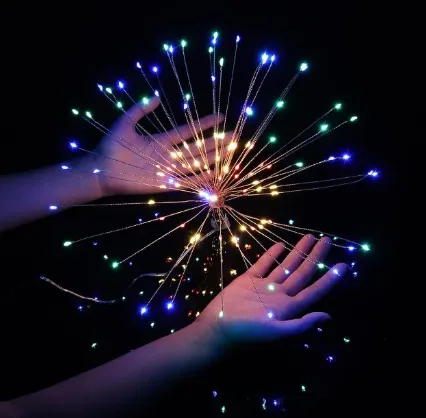
Flexible LED Array for Firework Solar Lights
Commercial-grade variants used in hotel courtyards and public parks often use rigid PVC or aluminum tube arms instead of flexible copper wire, providing a consistent silhouette that doesn’t shift in wind and supports a larger LED count — some commercial DMX-controlled models scale to 800 LEDs per fixture.
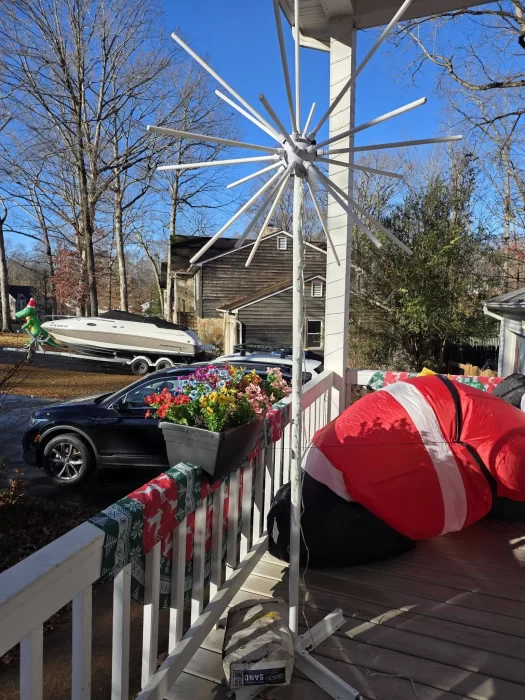
Rigid Arm Firework Solar Lights for Outdoor Projects
Lighting Modes and Control
Entry-level consumer models typically offer two modes: steady-on and slow-twinkle. Mid-range units marketed to professional buyers expand this to six to eight programmable flash patterns accessed via a bundled RF remote. Higher-end units use DMX512 control, allowing synchronized color and timing sequences across a large fixture array — the kind of orchestrated display used in resort entrance gardens or seasonal park installations.
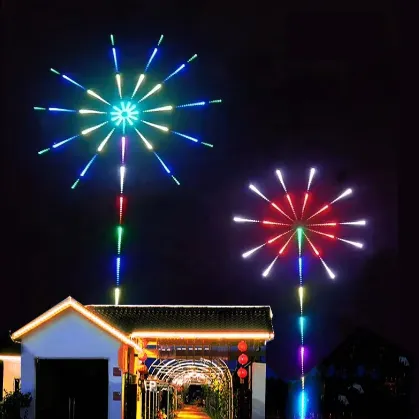
Color Changing Firework Solar Lights for Entrances
Solar vs. Plug-In for Outdoor Decoration Projects
The selection between solar-powered and wired plug-in firework lights is rarely about visual output alone. For most outdoor professional projects, the decision comes down to three practical variables: site infrastructure, installation timeline, and per-fixture running cost.
Installation and Wiring Cost Comparison
| Factor | Solar Firework Lights | Plug-In / Low-Voltage Wired |
|---|---|---|
| Upfront fixture cost | $15–$80 per unit (consumer); $120–$400 (commercial) | $30–$200 per unit |
| Wiring/trenching cost | $0 — no wiring required | $5–$13 per linear foot for buried wire |
| Electrician labor | Not required | $50–$100/hr; often required for 120V systems |
| Transformer + controls | Not required | $300–$500+ for commercial transformer |
| Typical 20-fixture project total | $400–$2,000 | $3,000–$6,000+ with professional install |
| Operating cost | $0 (solar) | Ongoing electricity cost |
| Repositioning | Stakes pull out and move in minutes | Wiring limits placement changes |
Wiring cost data sourced from Angi and LawnStarter 2025–2026 landscape lighting installation reports.
The gap narrows on large permanent installations. A wired low-voltage system installed by a specialist contractor typically carries a 5–10 year fixture warranty and L70-rated LEDs rated for 50,000 hours — meaningful for a hotel garden meant to run nightly for years. Solar firework lights at the consumer tier, by contrast, often carry 1–2 year warranties and may require solar panel or battery replacement within 3–4 years of daily outdoor use.
For temporary or seasonal installations — festival lighting, seasonal resort décor, pop-up event gardens — solar firework lights are the practical default. No conduit, no permits, no post-event remediation of buried wire.
When Wired Makes More Sense
On heavily shaded sites, wired wins unconditionally. Solar panels need direct sun exposure for 4–8 hours to deliver the 12–16 hours of runtime that product specs typically promise. A courtyard surrounded by tall buildings, a dense canopy garden, or a north-facing slope in a northern climate will produce inconsistent charging. On those sites, brightness will taper off in the second half of the night and performance will drop sharply in winter.
Wired systems also support precise dimming and multi-zone timer control at a level solar units cannot match — relevant for hospitality projects where lighting intensity needs to follow an evening schedule tied to dining or event programming.
Key Selection Criteria for Professional Outdoor Projects
IP Rating: What the Numbers Actually Mean
IP (Ingress Protection) ratings on firework solar lights follow IEC 60529 testing standards. The two most common ratings in this product category:
IP65 — fully dust-tight; protected against low-pressure water jets from any direction. Adequate for standard outdoor use including rain, garden irrigation, and coastal humidity. This is the minimum acceptable rating for any fixture intended for year-round outdoor installation.
IP67 — fully dust-tight; survives temporary submersion in up to 1 meter of water for 30 minutes. Relevant for fixtures placed near water features, drainage channels, or in regions with severe seasonal flooding.
Most consumer-grade solar firework lights are rated IP65. Professional commercial variants for permanent park or resort installation should be verified to IP65 minimum, with IP67 preferred for ground-level fixtures in wet zones.
One practical note: the IP rating applies to the fixture body and LED assembly. The solar panel and its connection cable are often the weakest point in a cheap unit. On procurement orders for commercial projects, request ingress protection documentation for the full assembly — panel, cable gland, and driver housing — not just the lamp head.
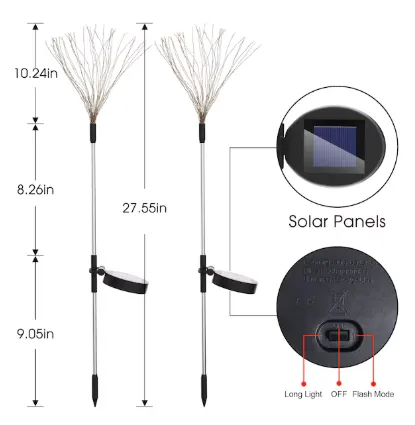
Firework Solar Lights Solar Panel and Size Diagram
LED Count and Light Coverage
The relationship between LED count and visual effect is not linear. A 120-LED fixture with well-spaced copper wires produces more visual volume than a 150-LED fixture with tightly packed strands. For projects where fixtures are viewed from a distance — a hotel entrance drive, a park pathway seen from 10–15 meters — the spread diameter of the array matters more than raw LED count.
A practical approach for specification:
- Close-viewing garden beds (within 3m): 90–120 LED, flexible copper wire, compact stake
- Pathway borders (3–8m viewing distance): 120–160 LED, wider spread, sturdy ABS stake minimum 40cm
- Commercial statement pieces (8m+ viewing, viewed from vehicle or elevated terrace): 300–800 LED commercial units, rigid tube arms, pole or truss mounting
Battery Capacity and Runtime
Most consumer firework solar lights ship with 600–800mAh batteries and promise 8–10 hours of runtime. Units with upgraded 1,200mAh batteries extend this to 12–16 hours — meaningful for hospitality projects where lights need to stay on from dusk through to midnight or later without dimming.
Battery capacity degrades over discharge cycles. A unit running nightly in a hotel garden will complete roughly 350 charge cycles per year. Quality NiMH or lithium cells maintain useful capacity for 500–800 cycles; cheaper cells may drop noticeably by year two.
For high-turnover commercial procurement (buying in bulk for a resort or park system), request cycle-life data from the supplier. It’s a reasonable ask and a reliable indicator of whether you’re buying professional-grade or consumer product with commercial branding.
Installation Guidance for Landscape and Commercial Projects
Ground-Stake Placement
Standard solar firework lights ship with a pointed steel or ABS stake sized for soft garden soil. For harder substrates — packed gravel paths, compacted clay, or decomposed granite — a pre-drilled pilot hole prevents stake damage and keeps the fixture vertical.
Stake depth affects stability in wind. Most 40–60cm copper-wire firework fixtures become unstable at heights above 35cm in exposed locations with consistent wind above 20 km/h. For exposed coastal hotel gardens or elevated park settings, consider units with wider base plates or use paired stakes with a cable tie at the mid-point of tall stems.
Solar panel orientation is the most common installation error on professional projects. The panel needs unobstructed southern exposure (northern hemisphere) or northern exposure (southern hemisphere). On a pathway bordered by hedges or tall grasses, even partial shading of the panel through part of the day will reduce charging meaningfully. Walk the site at midday and check actual shadow patterns before finalizing fixture positions.
Array Spacing for Visual Density
For the kind of dense, immersive effect seen in hotel garden photography, typical professional spacing is 60–80cm between firework starburst heads along a pathway edge. Tighter than 40cm creates visual noise; wider than 100cm produces an interrupted row effect rather than a cohesive display.
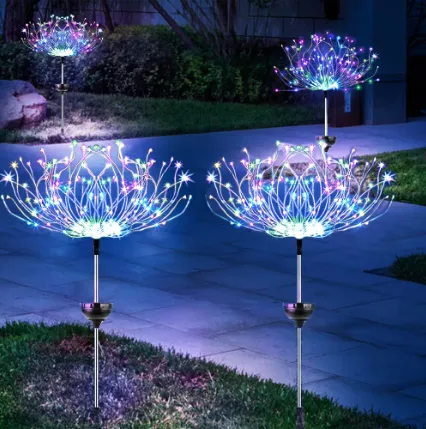
Garden Pathway Firework Solar Lights Installation
On garden bed installations where fixtures are grouped rather than lined, odd-number clusters (3, 5, 7 units) with varied wire shaping look more natural than symmetrical paired placement.
Seasonal and Temporary Deployment
For park departments or event companies rotating solar firework lights across multiple sites seasonally, the tool-free stake-and-go installation is a direct operational advantage. A team of two can deploy and configure 40–50 units in under two hours with no equipment beyond a rubber mallet.
Store solar firework lights with the switch in the off position. Leaving them on in storage draws from the battery without recharging, and some lower-quality units will not recover from a deep discharge. Label storage units by battery age to rotate older stock to front of deployment rotation.
Solar Firework Garden Lights: Common Use Scenarios
Hotel exterior gardens and courtyard borders — Solar firework lights work well for seasonal accent layers added on top of a permanent wired pathway system. They contribute visual depth without new wiring and can be replaced or repositioned between seasons.
Public park pathway lighting — For parks without electrical infrastructure at pathway level, solar firework lights provide decorative ambient light for evening visitors. They’re not security lighting — they don’t replace task lighting for visibility — but as a wayfinding visual layer in a park with existing overhead lighting, they’re low-cost and low-maintenance.
Landscape contractor rental and event install — Firework solar lights are fast to deploy and cost-effective to own at scale. For landscape firms offering seasonal lighting packages, a stock of 100–200 units covers most mid-scale residential and commercial event installs without repeated purchase.
Resort entrance drives and drop-off zones — Commercial solar firework units with rigid arms, mounted on low-profile decorative poles, create a visual signature at resort entrances. No trenching means installation doesn’t interrupt the landscape around the drive, and the fixtures can be updated or upgraded season by season.
Frequently Asked Questions
How long do solar firework lights actually run each night?
Runtime depends on battery capacity and panel charging conditions. Units with 1,200mAh batteries in full sun for 6–8 hours will typically run 12–16 hours. Units with 600mAh batteries may run 8–10 hours under the same conditions. On cloudy days, expect roughly 50–60% of rated runtime. In northern latitudes during winter months with 4–5 hours of usable sun, some units may not complete a full night before dimming.
What IP rating is adequate for hotel outdoor or park installation?
IP65 is the minimum for any year-round outdoor installation. It protects against rain and irrigation spray from any direction. If fixtures are placed at ground level near drainage, ponds, or in regions prone to heavy seasonal flooding, IP67 is the better choice. Avoid units that list only “waterproof” without a specific IP rating — it’s not a verifiable standard.
Can solar firework lights be used in shaded gardens?
Performance drops significantly in shaded conditions. Panels need at least 4–6 hours of direct sun to deliver advertised runtime. In partially shaded gardens — dappled light through a canopy, for instance — charging will be reduced and runtime will be shorter than specs suggest. For fully shaded courtyard or atrium applications, a wired plug-in system is the more reliable option.
What’s the realistic lifespan for commercial deployment?
Consumer-grade units at a hotel or park should be budgeted for replacement every 2–3 years. LED beads themselves last much longer — typically 30,000–50,000 hours — but battery capacity and panel efficiency degrade with outdoor exposure and charge cycles. Commercial-grade units with replaceable battery modules extend operational life significantly and are worth the higher per-unit cost on permanent or high-visibility installations.
The practical case for solar firework lights in professional outdoor projects is straightforward: they eliminate the wiring cost that makes small-to-medium decorative lighting projects expensive and logistically complicated. For a 30-unit hotel garden installation, avoiding trenching and electrical labor alone can save several thousand dollars compared to an equivalent low-voltage wired display. The trade-off is weather dependence and a shorter service life at the component level — manageable with good procurement criteria and realistic expectations about battery replacement cycles.
Data references
- Angi landscape lighting installation cost data, April 2026
- LawnStarter landscape lighting pricing guide, December 2025
- IEC 60529 Ingress Protection rating standard
- Sigostreetlight IP rating guide for outdoor solar fixtures, March 2026
Recommended internal link opportunities
- [firework solar lights for garden] — link to garden-specific product category
- [solar firework lights outdoor] — link to outdoor applications overview
- [solar firework garden lights] — link to residential garden collection